
The international nitrogen fertilizer market has entered a pause following the sharp price recovery recorded the previous week.
“The defining milestone of the week was the official confirmation that Indian state agency IPL managed to award only 410,000 tons of urea against its initial target of 1.70 million tons, due to massive resistance from Chinese suppliers to accept low price levels,” points out the weekly market report by consulting firm IF Ingeniería en Fertilizantes.
“This large shortfall of 1.29 million tons forces India to urgently launch a new public tender (via NFL or IPL) to cover the Rabi crop season, which acted as a support floor against fresh downward pressure in the Atlantic,” the report adds.
Against this backdrop, producers in major exporting regions maintained a firm sales stance, refusing to accept discounted “fire-sale” values and restricting spot availability of granular urea.
Demand across the Americas and Europe slowed following the previous rally, with buyers absorbing the fact that supply shortages in India will redirect global trade flows in November.
In Brazil, granular urea consolidated this week at 470–485 USD/ton CFR (with non-Chinese deals closing at 485 USD/ton CFR), while in the U.S. (NOLA FOB Barge) it traded at 430–435 USD/ton.
In Argentina, urea imports came to a halt. CFR values held at 510–520 USD/ton, carrying a 37.5 USD/ton premium over Brazil.
“Domestic demand mirrored the behavior of recent weeks. Beyond the windows opened by price ratios, the purchasing trigger remains planting logistics, and in such an erratic weather year (cold temperatures, low solar radiation, frosts, and intermittent rains), that seasonal reference point was lost,” the report highlights.
“Wholesale urea held steady for the second consecutive week at 595–605 USD/ton, slightly below replacement parity,” it notes.
Regarding urea, domestic production (estimated at 944,000 tons through September, +10% year-on-year) combined with imports (791,000 tons, -12% year-on-year) brings total supply to 1.74 million tons (-1% year-on-year) against dispatches of 1.81 million tons (+8% year-on-year).
“The -71,000-ton balance is the first negative reading since 2021: demand depleted the inherited inventories left by the heavy arrivals of late 2025,” the consultancy notes.
As for the international phosphate fertilizer market, it remains subdued in sluggish trading dynamics with a contained bearish bias. A key milestone of the week was the signing of the phosphoric acid supply contract between Jordan’s JPMC and India’s Coromandel at 1,700 USD/ton CFR, finalized for the fourth quarter of 2026 with prices frozen relative to the previous quarter, defying market expectations of price cuts.
Projected raw material costs provided some relief: the Tampa sulfur contract for the fourth quarter was negotiated at 615 USD/ton CFR (a 90 USD/ton contraction compared to values negotiated in the prior quarter), while Tampa ammonia traded at 545 USD/ton CFR (-10 USD/ton). Meanwhile, China continues to freeze DAP and MAP export licenses to protect its winter reserves.
In the U.S. (NOLA FOB), diammonium phosphate (DAP) traded this week at 800–805 USD/ton, while monoammonium phosphate (MAP) was quoted at 815–820 USD/ton.
“International physical demand remains lethargic. In the Western Hemisphere, buyers are postponing purchases due to affordability constraints and a lack of seasonal urgency. In South Asia, Indian and Pakistani importers remain on the sidelines following earlier replenishment, while Europe confirms a weak demand outlook toward year-end,” the report explains.
In Argentina, activity is near a standstill following failed negotiations with Morocco for the second half of November. DAP/MAP maintained nominal levels of 855–870 USD/ton CFR.
“In phosphorus, there is no cushion: MAP, DAP, TSP, and NPS combined recorded imports of 1.05 million tons (-8% year-on-year) and dispatches of 986,000 tons (+9%), leaving a surplus of just 68,000 tons—the lowest on historical record, which averages 242,000 tons,” indicates IF Ingeniería en Fertilizantes.
Imported MAP volume (504,000 tons; -18%) is the lowest in six years, while SSP, with 36,000 tons imported, represents an anomalous figure compared to the 2,016 tons imported during the same period in 2025.
“For phosphorus, an average of 303,000 tons of MAP are dispatched between October and December against typical imports of 189,000 tons; with no ongoing deals in place, product availability for late-planted corn and soybeans will hinge on arrivals picking up pace,” the consultancy anticipates. In the wholesale market, reference values for MAP and DAP stand at 965–995 USD/ton.
Source: Valor Soja
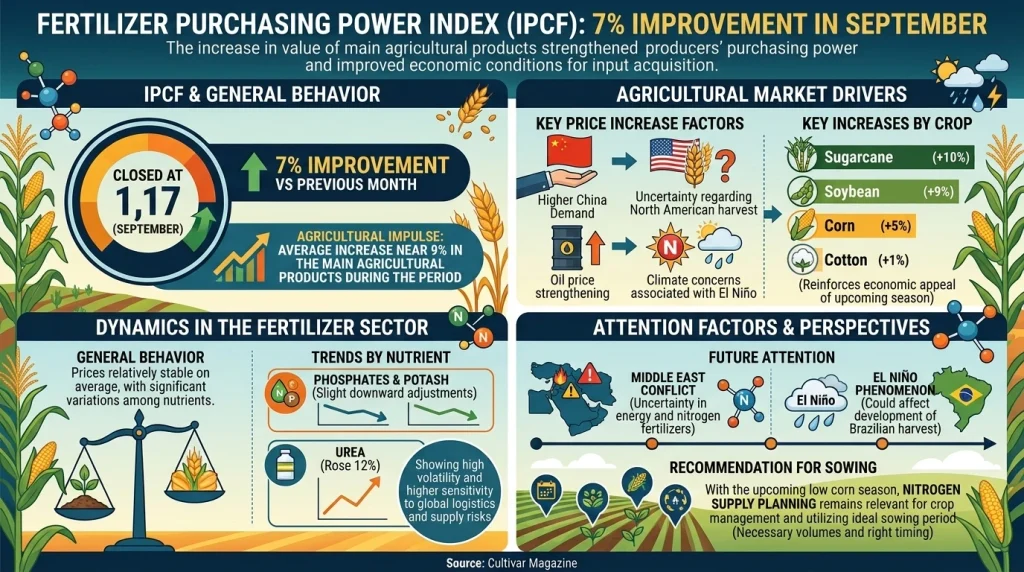
BRAZIL – Fall in fertilizer prices reduces IPCF by 7%
The movement reflected the increase in the value of major agricultural commodities in September.
The Fertilizer Purchasing Power Index (IPCF) ended September at 1,17, a 7% improvement compared to the previous month. This movement mainly reflected the appreciation of the main agricultural commodities, which registered an average increase of close to 9% during the period, strengthening the purchasing power of producers and improving economic conditions for the acquisition of inputs.
In the agricultural market, price increases were supported by increased Chinese demand, uncertainties regarding the North American harvest, strengthening oil prices, and climate concerns associated with El Niño. In this context, the increases in soybeans (+9%), sugarcane (+10%), corn (+5%), and cotton (+1%) stood out, reinforcing the economic attractiveness of the next season.
In the fertilizer sector, prices remained relatively stable on average, with distinct movements among nutrients. While phosphates and potassium showed small downward adjustments, urea advanced 12% during the period, with high volatility and greater sensitivity to global supply and logistics risks.
For the coming months, market attention should remain focused on geopolitical and climatic factors. The conflict in the Middle East continues to bring uncertainty to the international energy and fertilizer markets, especially nitrogen fertilizers, while El Niño may impact the development of the Brazilian crop.
With the next corn off-season approaching, planning nitrogen supply, considering the necessary volumes and the appropriate timing of application, remains relevant for crop management and for meeting the ideal planting window.
Source: Cultivar Magazine
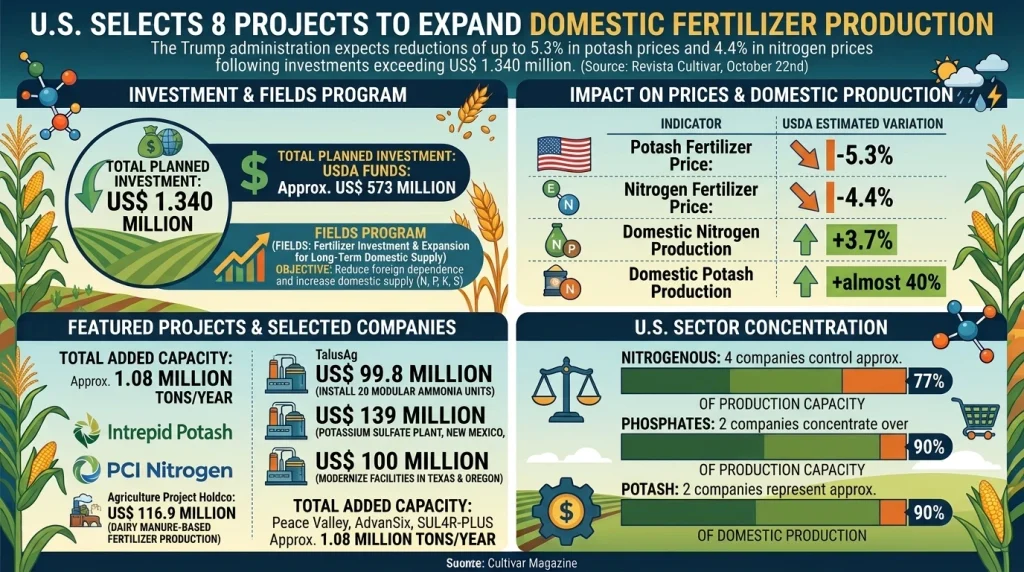
The US announces $1,34 billion for fertilizer production
The Trump administration has selected eight industrial projects and anticipates a reduction of up to 5,3% in the prices of potassium fertilizers
The United States government announced today (October 22) the selection of eight projects to expand domestic fertilizer production. The planned investments exceed US$1,34 billion, including approximately US$573 million in funding proposed by the United States Department of Agriculture (USDA). The initiative seeks to reduce dependence on foreign suppliers and increase the supply of agricultural inputs.
The projects are part of the Fertilizer Investment & Expansion for Long-Term Domestic Supply (Fields) program. This initiative involves investments in production units for nitrogen, phosphate, potassium, and sulfur fertilizers.
According to USDA estimates, expanding industrial capacity could reduce nitrogen fertilizer prices by 4,4% and potash prices by 5,3%. Domestic nitrogen production could grow by 3,7%, while potash production could increase by almost 40%, after the facilities become operational.
Selected projects: The eight selected projects represent an estimated capacity of approximately 1,08 million tons of fertilizer per year.
TalusAg was selected to receive approximately US$99,8 million for the installation of 20 modular ammonia production units. Intrepid Potash may receive US$139 million to build a potassium sulfate plant in New Mexico, with an annual capacity of 220 tons.
PCI Nitrogen may receive $100 million to modernize facilities in Texas and Oregon. Agriculture Project Holdco was selected to receive $116,9 million for the development of fertilizer production facilities using dairy cattle manure.
Also included in the selection are Peace Valley, AdvanSix, SUL4R-PLUS Illinois, and True Organic Products.
Concentration in the sector: The USDA points to a high level of concentration in the sector. Four companies control approximately 77% of the US nitrogen fertilizer production capacity. Two companies concentrate more than 90% of the phosphate capacity, and two account for approximately 90% of US potassium production.
Cultivar Magazine
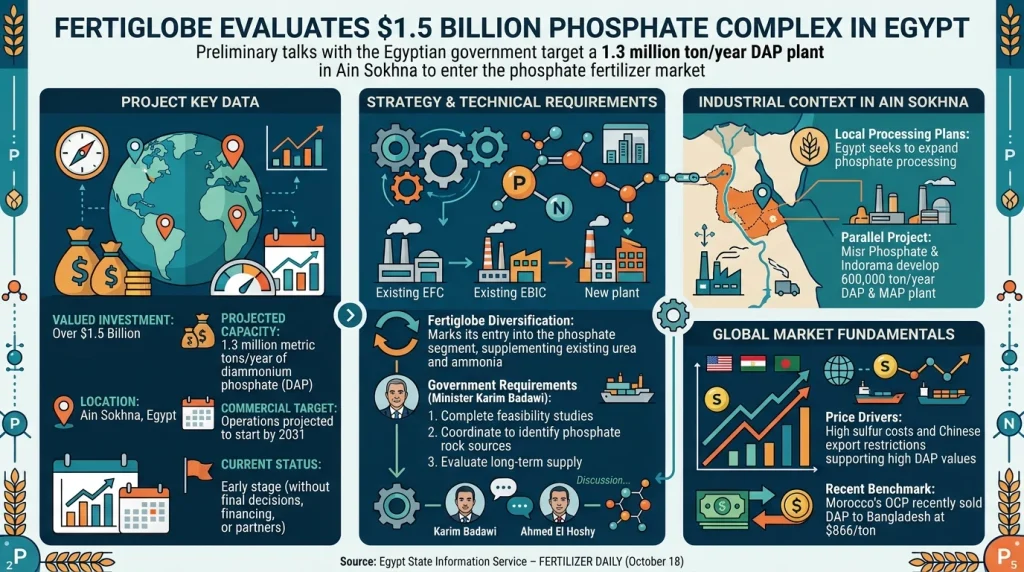
Fertiglobe weighs $1.5 billion phosphate fertilizer project in Egypt
Fertiglobe is in preliminary discussions with the Egyptian government over a phosphate fertilizer complex worth more than $1.5 billion, with planned production capacity of 1.3 million tonnes of diammonium phosphate (DAP) annually.
According to Egypt’s Ministry of Petroleum and Mineral Resources on October 18, the project would be located at Ain Sokhna, with commercial operations targeted for 2031. Egypt’s Petroleum and Mineral Resources Minister Karim Badawi discussed the preliminary plans with Fertiglobe CEO Ahmed El Hoshy.
The minister called on Fertiglobe to complete technical and economic feasibility studies and coordinate with the Mineral Resources and Mining Industries Authority to identify phosphate rock sources and assess long-term supply. The project remains at an early stage, with no final investment decision, financing arrangements or project partners announced. If developed, it would mark Fertiglobe’s entry into phosphate fertilizers, complementing its existing urea and ammonia operations at Ain Sokhna through the EFC and EBIC plants.
The proposed complex would add to Egypt’s plans to expand domestic phosphate processing and strengthen its position in international fertilizer markets. Misr Phosphate and Indorama are separately developing a 600,000-tonne-a-year DAP and monoammonium phosphate (MAP) project at Ain Sokhna. Market conditions could support additional capacity, as sulfur costs and Chinese export restrictions have contributed to elevated DAP prices. Morocco’s OCP recently sold DAP to Bangladesh at $866 per tonne. If completed, Fertiglobe’s proposed plant could make Egypt a significant additional DAP supplier early next decade, although its prospects will depend on securing reliable phosphate rock and sulfur supplies.
Source: Egypt State Information Service _ FERTLIZER DAILY
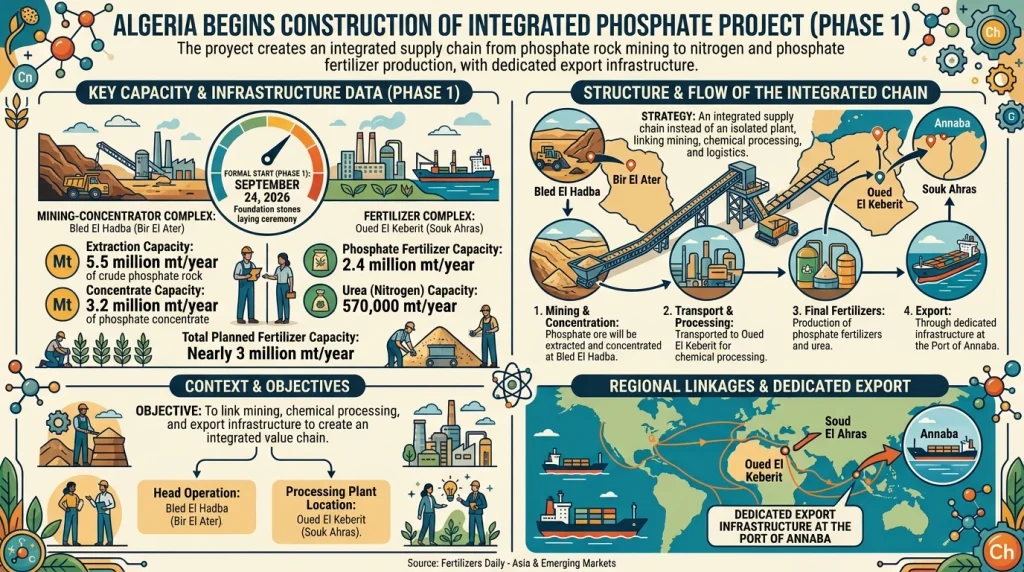
Algeria Launches 3M t/y Phosphate and Urea Fertilizer Project
Algeria is developing an integrated phosphate-to-fertilizer production chain linking mining, chemical processing and export infrastructure.
Algeria has formally launched construction of the first phase of its Integrated Phosphate Project, a large mining-to-fertilizer development designed to connect the Bled El Hadba phosphate deposit with new fertilizer production facilities at Oued El Keberit and dedicated export infrastructure at the Port of Annaba.
The project moved into its latest construction phase on September 24, 2026, when Algerian officials laid the foundation stones for both the Bled El Hadba extraction and beneficiation complex and the Oued El Keberit chemical processing and fertilizer complex. According to Sonatrach, Phase 1 is designed to produce 2.4 million tonnes of phosphate fertilizers per year and 570,000 tonnes of urea per year.
That gives the fertilizer complex planned capacity of almost 3 million tonnes per year, while the upstream Bled El Hadba operation is designed to extract 5.5 million tonnes of raw phosphate rock annually and produce 3.2 million tonnes of phosphate concentrate.
Algeria begins construction of an integrated phosphate-to-fertilizer chain
The project is structured as an integrated supply chain rather than a standalone fertilizer plant. Phosphate ore will be mined and beneficiated at Bled El Hadba in the Bir El Ater area before being transported to Oued El Keberit in Souk Ahras for chemical processing.
Source: Fertilizers Daily – Asia & Emerging Markets

ARGENTINE MAIN CROPS OVERVIEW
CORN: As of this report, commercial grain corn planting has reached 39.8% of the projected 8.4 million hectares, following a week-on-week progress of 5 percentage points. Early planting schemes are close to completion across much of the Core Zone (Zona Núcleo) and East-Central Entre Ríos. Meanwhile, toward the west and south, low temperatures and rainfall continue to delay fieldwork, shifting some fields toward late-planting windows in certain areas. Regarding established fields, the crop is mostly progressing between emergence and leaf differentiation. In North-Central Santa Fe, both Core areas, and parts of western Buenos Aires, low temperatures, low solar radiation, and scattered frosts have caused uneven emergence and leaf yellowing. Despite this, crop condition remains predominantly Normal to Good, backed by Adequate to Optimal soil moisture conditions.
SUNFLOWER: Sunflower planting recorded a week-on-week advance of 8.4 percentage points, covering 50.3% of the 3.1 million hectares projected for the current season. This represents a 10-percentage-point lead over the historical average, though narrowing the advance compared to the 5-year average to just 1.4 percentage points. Across the southern agricultural belt, continuous rainfall and cold temperatures have slowed fieldwork, despite adequate topsoil moisture for crop establishment. Meanwhile, in parts of the central and northern agricultural belt—specifically in the NEA and North-Central Santa Fe regions—collaborators report the need for fresh rainfall to support crop development, with the most advanced fields transitioning between floral budding and early grain filling.
WHEAT: To date, 38.1% of wheat fields are moving between flowering and grain filling, concentrated mainly across the central and northern agricultural regions. In the provinces of Buenos Aires and La Pampa, persistent low temperatures are keeping the crop between tillering and heading. Despite improved moisture supplies from the previous week, overall crop condition shows no significant variation. This is primarily due to persistent overcast skies and drizzle, which reduce solar radiation and the photothermal quotient during critical stages; if not reversed, this could compromise yield potential. Additionally, as a result of frosts in September and more recent events in mid-October—with damage assessments still underway—yield losses between 10% and 15% are reported, mainly in early plantings and short-cycle varieties across southern Santa Fe, Entre Ríos, Buenos Aires, and La Pampa. Furthermore, high relative humidity has favored the spread of foliar diseases, prompting fungal controls along with preventive applications against Fusarium head blight in flowering fields. In the far north, persistent drizzles continue to delay the onset of harvest and raise concerns regarding grain quality.
Source: Buenos Aires Grain Exchange