
Nearly two-thirds of US corn producers had purchased at least 80% of their nitrogen fertilizer needs for 2026 before the price surge triggered by the Middle East war, while 9% have yet to purchase anything, a significant number given the current situation.
This was determined by a survey conducted by the National Corn Growers Association (NCGA), which found that, thanks to advance purchases, the US corn acreage will not be significantly affected in 2026.
Furthermore, more than 70% of those surveyed by the NCGA indicated that they had purchased at least 80% of their phosphate fertilizer needs for 2026, while about 12% reported having purchased nothing.
While the situation will affect a minority in the current 2026 growing season, most of those surveyed expressed concern about what might happen in 2027 if fertilizer prices remain high.
The NCGA survey results show that for every farmer who expresses greater concern about fertilizer prices and availability for the 2026 harvest, almost two farmers express greater concern about the 2027 season.
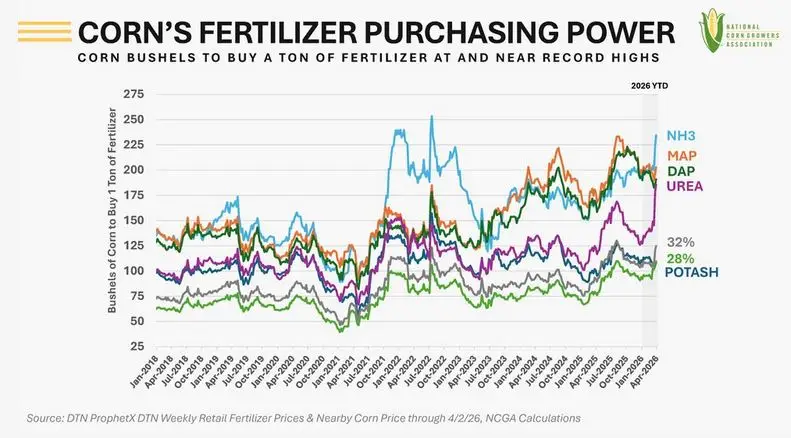
This is because, although fertilizer prices are still below the peaks recorded in 2022 following Russia’s invasion of Ukraine, price ratios are steadily worsening, as the price of corn has fallen significantly behind.
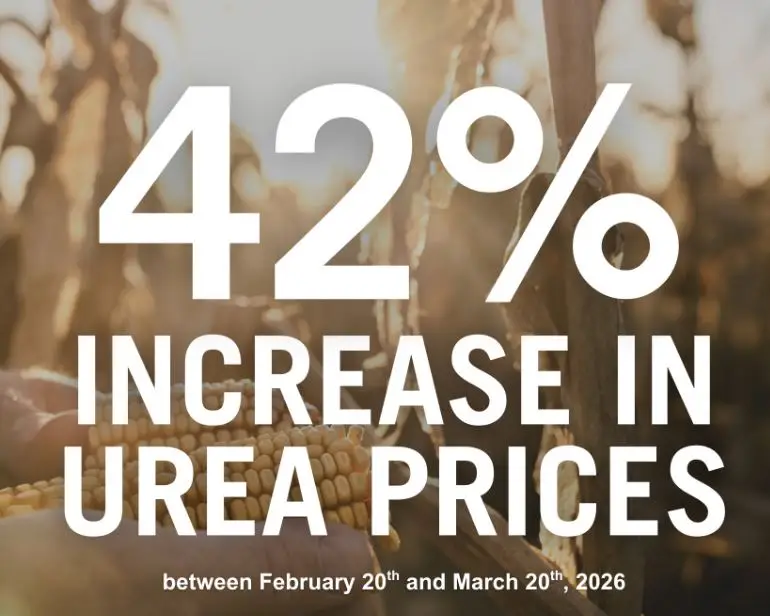
“In terms of ‘corn currency,’ U.S. farmers now need a record 4.7 tons of corn to buy one ton of urea, even though the fertilizer is still selling below its 2022 peak,” the NCGA report states.
“Half of the NCGA members surveyed do not foresee any problems applying the full fertilizer dose projected for the 2026 growing season. Of the other half, 36.7% cite price as the main constraint, 10.7% cite availability, and 2.4% cite drought conditions,” it adds.
Source: Valor Soja
Argentina: Pampa Energía Considers Multimillion-Dollar Investment
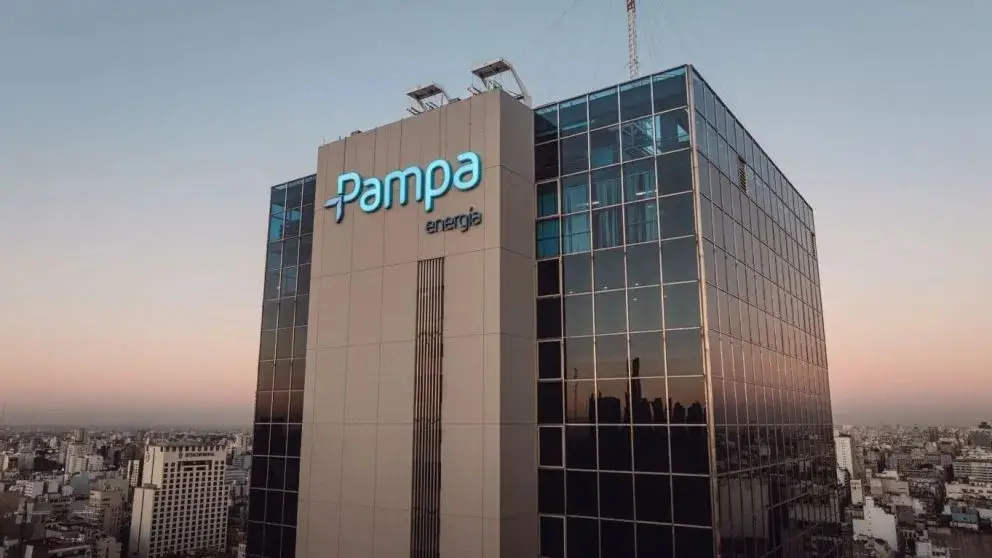
Pampa Energía is considering investing in a urea plant in Bahía Blanca with IDB financing, amidst a global rise in key agricultural inputs.
Pampa Energía, the company led by Marcelo Mindlin, is considering moving forward with an investment of up to US$1.5 billion to build a granulated urea plant in Bahía Blanca, with financing from the Inter-American Development Bank (IDB). The initiative, for which a final decision has not yet been made, comes amid a sharp international increase in fertilizer prices and Argentina’s high dependence on imported inputs, a critical factor for the profitability of the agricultural sector.
The project is being promoted through Fertil Pampa S.A.U., a subsidiary of the energy company, which submitted a syndicated loan proposal to the multilateral organization at the end of March. The scheme envisions total financing of up to US$1.5 billion, with direct participation from IDB Invest of US$300 million and additional structured funds of up to US$1.2 billion, with a term of up to nine years.
If finalized, the investment will be allocated to the design, construction, operation, and maintenance of a granulated urea plant, a key input for Argentine agricultural production, especially in extensive crops where fertilization directly impacts yield and the efficiency of the no-till farming system.
The project’s progress coincides with a complex international scenario. Since the end of February, the conflict in the Middle East has generated sharp increases in fertilizer prices, driven by the rising cost of natural gas—the main input for urea production—and by logistical disruptions on strategic trade routes. In this context, Argentina faces a structural challenge: it imports approximately 80% of the fertilizers it consumes, which exposes the sector to external volatility and higher production costs.
For producers, this scenario has a direct impact on campaign planning, influencing decisions regarding fertilization levels, input management, and marketing strategies, in a context where margins are under pressure from both grain prices and the cost of agrochemicals and fertilizers.
The industrial project envisions a comprehensive infrastructure that includes an ammonia and carbon dioxide production plant, granulated urea units, storage and distribution facilities, and gas, water, and energy supply systems—key elements for ensuring scale and operational efficiency. The location in Bahía Blanca is significant: it is a strategic logistics hub that facilitates integration with the value chain and improves distribution to the main production areas.
Although Pampa Energía has not yet finalized the investment, the project analysis reflects a strategic move toward diversification within agribusiness. The company, with a strong presence in electricity generation, gas and oil production, as well as holdings in cement and timber, could thus add a new link directly related to the supply of critical inputs for agriculture.
In a context of growing global food demand and challenges associated with climate change, initiatives of this kind also align with the need to strengthen sustainability and productive efficiency, reducing external dependence and providing predictability to one of the most sensitive factors for Argentine agricultural production.
Source: AgroLatam.com
Brasil: Fertilizer deliveries grew 5,3% in January
Data from Anda indicates a volume of 3,87 million tons in the first month of 2026.
Fertilizer deliveries to the Brazilian market totaled 3,87 million tons in January 2026. This volume represents a 5,3% increase compared to the same month of the previous year, when 3,67 million tons were sold, according to the National Association for the Diffusion of Fertilizers (Anda).
Leading in deliveries to the market, the state of Mato Grosso accounts for 29,7% of the national total, equivalent to 1,14 million tons. Following are Goiás (468 tons), Paraná (400 tons), São Paulo (357 tons), and Minas Gerais (320 tons).
National production of intermediate fertilizers ended January 2026 at 497 tons. This represents a 23% decrease compared to the same month in 2025, when 647 tons were produced.
Imports in January 2026 totaled 3,16 million tons. This represents a 5,4% increase compared to the same period of the previous year, when three million tons were imported.
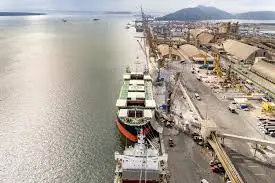
At the port of Paranaguá, the main entry point for fertilizers in Brazil, 786 tons entered the country during the period, a 9,5% increase compared to 2025 (718 tons). The terminal accounted for 24,8% of the total for all ports (source: Siacesp/MDIC).
Source: Cultivar Magazine
Spanish Group Plans Green Fertilizer Plant in Paraguay with Investment That Could Exceed US$400 Million
Paraguay could gain a new industrial project linked to fertilizer production and the energy transition. The Spanish group Novargi Group presented an initiative to develop a green fertilizer plant in the city of Villeta, with a total projected investment that could exceed US$400 million, according to the Ministry of Industry and Commerce (MIC).
According to official information, the project is planned in two investment phases. The first involves an estimated outlay of US$220 million, while a second phase would allow for a total investment exceeding US$400 million, intended to expand the plant’s production capacity.

However, official sources consulted by Valor Agro indicated that the company is currently in the process of raising capital to carry out the initiative. They explained that the final investment needed to begin construction has not yet been fully secured, as the project is in the financial structuring stage.
The proposal was presented by company representatives during a meeting with authorities from the Ministry of Industry and Commerce, where the details of the project and Paraguay’s potential to host this type of industrial project related to clean energy were outlined.
The project aims to produce fertilizers using renewable energy and green hydrogen, an input that allows for the development of chemical products with a smaller environmental footprint compared to traditional processes.
According to the company’s vice president, Daniel Pascual, the system is based on using clean energy to produce hydrogen, which is then transformed into the chemical base of the fertilizers. “What we will use is green energy to generate green hydrogen, which is the chemical basis for developing the fertilizer,” he stated.
Among the products they plan to manufacture are ammonium sulfate (SAM), calcium ammonium nitrate (CAN), and eventually urea, inputs widely used in modern agriculture.
The initiative is part of an effort to attract investments related to industrialization and the green economy, taking advantage of the country’s renewable energy resources. In this context, Paraguay emerges as an attractive platform for projects related to green hydrogen and its derivatives, a segment that is beginning to gain prominence within the new energy and chemical industry globally.
Novargi Group is an engineering company with an international presence and offices in various markets, developing projects related to energy transformation and the sustainable chemical industry.
Source: Valor Agro PY
ARGENTINA MAIN CROPS OVERVIEW:
SOYBEANS: As of this report, rainfall has again been recorded across much of the agricultural area. Regarding soybean cultivation, this has caused delays in harvesting first-crop plantings in both core areas: southern Córdoba and northern La Pampa/western Buenos Aires. Under these circumstances, the harvest covers only 2.4% of the total planted area, concentrated mainly in the northern and southern core areas, where reported yields average 34.6 quintals/hectare and 40.4 quintals/hectare, respectively. Meanwhile, with harvesting underway in northern La Pampa/western Buenos Aires, the average yield is 39.6 quintals/hectare. As for second-crop soybeans, with almost 80% having entered the grain-filling stage, the crop condition rating (Normal/Excellent) shows a week-on-week increase of 4 percentage points, associated with improvements in soil moisture profiles. Under this scenario, the production forecast remains at 48.5 million tons.
CORN: Regarding corn, the harvest continues to progress nationally, reaching 21.6% of the suitable area, with an average yield of 85.5 quintals per hectare. However, after the recent rainfall that interrupted harvesting operations, farmers are awaiting improved soil conditions to allow them to resume work in the fields. Regionally, yields are at 99.3 quintals per hectare in the Northern Core region and 94.3 quintals per hectare in Northern La Pampa and Western Buenos Aires. As for late-planted corn, most of the area is in the grain-filling stage, in a context where crop conditions have shown sustained improvement over the last four weeks, currently reaching 95% of cases between Normal and Excellent. This recovery is most evident in southeastern Buenos Aires province, where the area under Normal to Excellent crop conditions has increased from 50% to 95% (+45 percentage points) in the last month.
SUNFLOWER: Meanwhile, the sunflower harvest is slowing due to the aforementioned rains, showing week-on-week progress of 7 percentage points, covering 83.5% of the suitable area to date. The intensity and extent of the events of the last week have led to waterlogging in 18.8% of the standing crop, concentrated mainly in central and western Buenos Aires province. Adding to this situation is the marked drop in temperature, which is hindering soil drying and making it difficult to restore the usability of both fields and roads. Consequently, there is a delay of 7.6 percentage points compared to the average progress of the last five seasons. Regarding yields, while the western and southwestern agricultural regions continue to produce results similar to or better than the previous cycle, the central and southeastern Buenos Aires provinces are at or below the same level, but still above the average of the last five years. Under this context, the production forecast remains at 6.4 million tons (MTn).
SORGHUM: Finally, the grain sorghum harvest continues to progress, reaching 15.5% of the estimated national area, with an average yield of 46.3 quintals per hectare (qq/Ha), representing a year-on-year delay of 5.5 percentage points. Given this scenario, with excessive rainfall in several areas of the agricultural region, harvesting could continue to be delayed in the coming days. However, with respect to crop development, more than 90% of the area is in Normal to Excellent condition, allowing us to maintain a production forecast of 2.9 MTn.
Source: Buenos Aires Grain Exchange