
The price of the fertilizer dropped sharply last month and is now hovering between US$650 and US$700 per ton. This change opens the possibility of a new planting record for corn.
With this further decrease in urea prices, to more normal levels, producers are beginning to rethink their investment options for both wheat and the upcoming corn planting season.

“It is not common to apply nitrogen after planting in the core agricultural region, but with more affordable nitrogen fertilization, producers are considering large-scale topdressing. The aim is to bolster yield potential in a season where water scarcity is not seen as a limiting factor and to generate the necessary yields to exceed profit margins,” stated the Rosario Board of Trade.
The BCR report highlights that there are already areas where a reactivation in fertilizer sales is being observed, and many producers plan to complete applications during the tillering stage.
Wheat Numbers
The Exchange report indicates that “currently, the projected net margin for owned land is US$86/ha, US$8 less than a month ago. For rented land, the difference compared to May is even lower at US$3, resulting in a margin of US$106/ha. However, in the last month there was a sharp drop in urea prices: from US$950/t to a range of US$650 to US$700. The decrease is between 25% and 30%. Nevertheless, the improvement in current margins was offset by other factors.”
Among these factors, the drop in the expected harvest price stands out, falling from US$231 to US$212/t (-8%). “This decrease was due to higher expectations for global supply, and although drought problems persist in some producing regions, the market interpreted that the global availability of wheat would be sufficient to meet demand,” they emphasized.
The other key factor is the increased cost of labor. “In this regard, an increase of approximately 8% in the value of the UTA (Agricultural Tariff Unit) has driven up labor costs: “These costs have been rising, and depending on the type of work, there have been increases of between 70% and 150% compared to a year ago.”
Source: TodoAgro

U.S. urea exports to Canada hit record high in April
U.S. urea exports to Canada reached 144,619 tonnes in April, the highest for any month since records began in 2008, according to the U.S. Census Bureau data reported by Argus.
The volume was up 99,086 tonnes from a year earlier and ran 94,946 tonnes above the five-year average for April. The surge reflects reduced Canadian domestic production rather than any shift in trade policy.

Several Canadian nitrogen plants cut output over the spring. Nutrien carried out a turnaround at its Carseland plant in Alberta in April, while Yara scheduled maintenance at its Belle Plaine facility in Saskatchewan in late May.
The maintenance left Canadian buyers leaning on US-produced urea during the spring application window, when demand for nitrogen peaks across the Prairies and the northern United States.
The shift puts the United States on track to remain a net exporter of urea to Canada through the 2025-26 fertilizer year, reversing the more typical flow seen in some earlier periods.
Source: World Fertilizer
Argentina Potash secures US funding for potash project
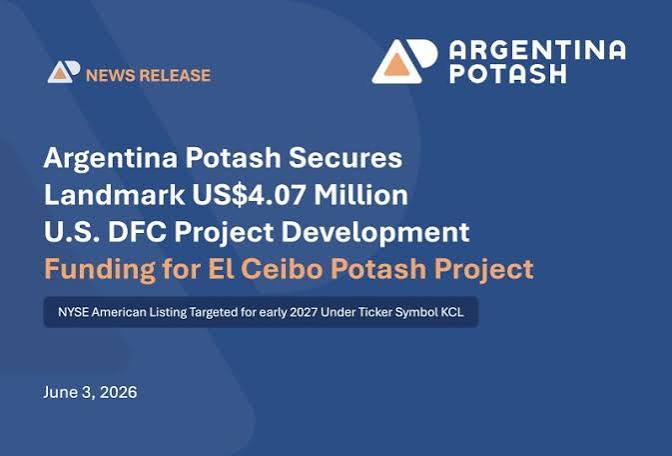
Argentina Potash Corp., an exploration and development company focused on the responsible development of potash resources in Argentina, has announced that the US International Development Finance Corp. (DFC) has approved US$4.07 million in project development funding for its flagship El Ceibo Potash Project in the Neuque´n Basin.
This landmark transaction represents the first DFC Project Development funding awarded in Argentina. It is also the first project to directly align with the US-Argentina Critical Minerals Framework Agreement signed in February 2026, following the designation of potash as a US critical mineral in November 2025.
The US$4.07 million DFC funding is expected to be matched dollar-for-dollar by strategic investors, resulting in total Phase 1 funding of US$8.15 million. These proceeds will advance technical studies, environmental, and social impact assessments (ESIA), and pre-feasibility work, accelerating the company’s path toward construction of a 50 000 tpy Demonstration Plant – a critical milestone on the road to full scale commercial production of 1 million tpy of muriate of potash (MOP).
At commercial scale, El Ceibo would rank among the most significant potash development projects in the Western Hemisphere.
Dr Chris Cornelius, Chairman and CEO of Argentina Potash Corp., commented: “This DFC partnership marks a pivotal step forward for the El Ceibo Project and our vision for the Southern Cone. The project is positioned to become a meaningful new source of potash for the Western Hemisphere, supporting long- term agricultural productivity across Argentina, Brazil, Uruguay, and Paraguay. We are excited to advance this important initiative alongside the DFC and our strategic partners.”
The company is targeting a listing on the NYSE American in early 2027 under the ticker symbol KCL.
Project overview
El Ceibo hosts an inferred mineral resource of 1606 million t of sylvinite containing an estimated 391 million t of potassium chloride (KCl), making it one of the largest defined potash deposits in South America. Strategically located near existing infrastructure in Argentina’s Neuque´n Basin, the project is well positioned to serve the agricultural heartlands of the Southern Cone.
The company plans to utilise horizontal drilling and selective solution mining techniques designed to minimise surface disturbance, water consumption, and overall environmental impact.
Source: World Fertilizer

EU Commission proposes €540M relief package for farmers facing fertilizer crisis

The European Commission has proposed a €540M relief package to help farmers cope with surging fertilizer costs, the first concrete funding step under its Fertilizer Action Plan.
The Commission will channel €300M of fresh money from the 2026 EU budget into the agricultural reserve, on top of remaining funds, bringing the total to €540M. Member states may top up the support with national funds by up to 200%, raising the potential package to €1.5B.
Alongside the direct aid, the Commission proposed targeted changes to the Common Agricultural Policy. These include a new crisis liquidity scheme under the rural development program, the option for member states to bring forward direct payments, and higher advance payment rates before October 16 to ease farm cash flow.
Fertilizer prices have climbed sharply since the Middle East conflict disrupted nitrogen supply. Nitrogen fertilizer prices in April 2026 ran 71% above the 2024 average, according to Commission data, while the bloc imports 40% to 45% of the fertilizers its farmers use.
The agricultural reserve proposal goes to member states for a vote, with final adoption scheduled by the end of July.
Source: European Commission
ARGENTINA MAIN CROPS OVERVIEW:
WHEAT: Wheat planting showed a week-on-week increase of 13.4 percentage points. Despite the lack of rain, low temperatures and high humidity are hindering soil conditioning across the entire southern agricultural region, where delays in machinery access continue to worsen. To date, 57.6% of the projected 6.5 million hectares for the 2026/27 cycle have been planted, maintaining a 16.6 percentage point lead over the historical average. In the Northwest (NOA), planting is complete, while in the Northeast (NEA), areas with access difficulties remain to be sown. However, in both regions, planted fields are progressing through the initial development stages with good plant stand. In the rest of the agricultural area, uniform emergence is observed in the first sown hectares.
SOYBEANS: After a week-on-week increase of 2 percentage points, the soybean harvest has reached 97.2% of the suitable area nationwide. To date, the national average yield stands at 31.6 quintals per hectare (qq/Ha), remaining above the previous season. Harvesting operations are concentrated in the southern part of the agricultural area, where some of the area still needs to be harvested and yields reported continue to be below average. In contrast, much of the central and northern agricultural area has already finished harvesting, maintaining yields above the historical average. As for second-crop soybeans, with a harvest progress of 92.9%, the national average yield stands at 26.1 qq/Ha, also above the previous cycle. Under this scenario, the production projection remains at 50.1 million tons (MTn).
CORN: Meanwhile, the commercial grain corn harvest advanced 4.6 percentage points week-on-week, reaching 48.2% of the suitable area nationwide. The average yield is around 81.4 quintals per hectare (qq/Ha). In the Northern Core region, harvesting is becoming widespread on late-planted crops, with an average yield of 79.3 qq/Ha. Conversely, in central and southern Buenos Aires province, harvesting of these crops continues to be hampered by high grain moisture, which limits the progress of combine harvesters. Under this scenario, the national production projection remains at 64 million tons (MTn), representing a 30.6% increase compared to the previous cycle (2024/25 production: 49 MTn).
SORGHUM: The grain sorghum harvest continues to progress, reaching 62.8% of the suitable area nationwide after a two-week increase of 15.4 percentage points, with an average yield of 43.1 quintals per hectare. As harvesting progresses in the main producing regions, yields are showing favorable performance, particularly in North-Central Córdoba, where the average yield has reached 56.2 quintals per hectare. Likewise, both the Northeast region and North-Central Santa Fe are registering higher yields than those observed in previous seasons. Given this scenario, the production forecast remains at 2.9 million tons.
Source: Buenos Aires Grain Stock