
Fertil Pampa is building storage silos, a desalination plant, and dedicated docks in Bahía Blanca to export 2.1 million metric tons of granulated urea per year. Meanwhile, in the Rosario industrial corridor, a competing project remains stalled at square one: it still lacks a dedicated gas pipeline.
The Logistics Infrastructure Behind Bahía Blanca’s Urea Exports
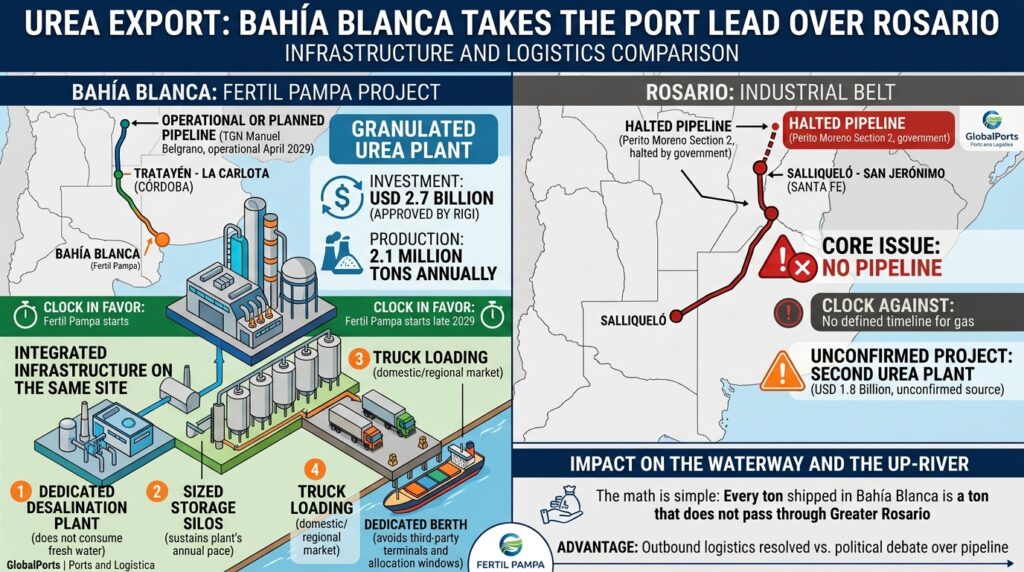
Bahía Blanca’s urea export initiative is taking shape on Pampa Energía’s blueprints: storage silos, a proprietary desalination plant, and docks designed to load both trucks and dry-bulk carrier vessels for export markets.
This constitutes the logistics infrastructure for Fertil Pampa—the granulated urea plant being developed by Marcelo Mindlin’s business group through a USD 2.7 billion investment, already approved under the RIGI incentive framework. The facility is expected to begin producing 2.1 million metric tons annually by late 2029. By contrast, 650 kilometers away in the Rosario industrial belt, the opposite side of the same equation—converting Vaca Muerta gas into fertilizer for export via the Paraná River—has yet to resolve its most basic hurdle: it still lacks a gas pipeline.
The contrast is no coincidence. TGN recently presented the Manuel Belgrano Gas Pipeline, a 753-kilometer trunk line connecting Tratayén to La Carlota (Córdoba) representing a USD 2.2 billion investment. Meanwhile, the section intended to connect Vaca Muerta with Santa Fe—the second stage of the Perito Moreno Gas Pipeline between Salliqueló and San Jerónimo—remains halted by the Milei administration since 2024.
This halted section would pass through the San Lorenzo department, the heart of the industrial and port hub where Pampa closed its synthetic rubber plant in July, and where unconfirmed reports circulate regarding a potential second urea plant valued at approximately USD 1.8 billion.
Why Natural Gas Supply Fails Without a Dedicated Pipeline
A urea plant without an established export outlet cannot compete: production must reach markets with logistics costs that do not erode operating margins. Bahía Blanca started solving this equation even before the gas basin connection was completed.
Fertil Pampa’s engineering plan integrates the following on a single site:
- Desalination plant: Prevents compromising freshwater resources from the local basin for an industrial process of this scale.
- Storage silos: Dimensioned to sustain the operating pace of a plant that produces year-round but exports via vessel within discrete shipping windows.
- Truck-loading facilities: Designed to serve the domestic and regional markets via overland transport.
- Dedicated vessel dock: Avoids reliance on third-party terminals and their allocation schedules in a port that also handles hydrocarbons, LNG, and agricultural exports.
This level of integration—combining plant, storage, and dock under a single operator—is something any urea project in the Rosario corridor currently lacks, and cannot even begin to develop, until the primary question is answered: where the gas will come from.
Bahía Blanca Runs on a Favorable Timeline
The chronology works against Santa Fe. The Belgrano pipeline would only become operational in April 2029, seven months before Fertil Pampa begins production; however, that pipeline runs through Córdoba rather than Rosario.
For the Santa Fe corridor, there is not even a clear benchmark: the national government replaced the original infrastructure project with smaller-scale compression expansions, lacking both open bidding and a defined timeline.
The SOEPU petrochemical union is promoting a provincial bill to declare the Salliqueló-San Jerónimo pipeline section of public, strategic, and priority interest—a policy push with a clear target, but one that has yet to unblock progress on the ground.
The Missing Link for the Paraná River Complex
For the inland waterway, the math is straightforward: every ton of urea slated for shipment through Bahía Blanca is a ton that bypasses the terminals of Greater Rosario and generates no activity for the Up-River port complex—at a moment when the area seeks economic conversion following the synthetic rubber plant closure.
The advantage of Bahía Blanca’s urea export initiative goes beyond gas availability: it lies in having first secured its outgoing logistics. While political debate centers on which province will host the next gas pipeline, the fertilizer export business is already being played—and won—port by port.
Source: GlobalPorts | Ports & Logistics
Brazil to Expand Planted Area but Will Import Up to 5 Million Tons Less Fertilizer
External purchases could drop to 40–41 million metric tons in 2026, down from last year’s record of 45.5 million tons.
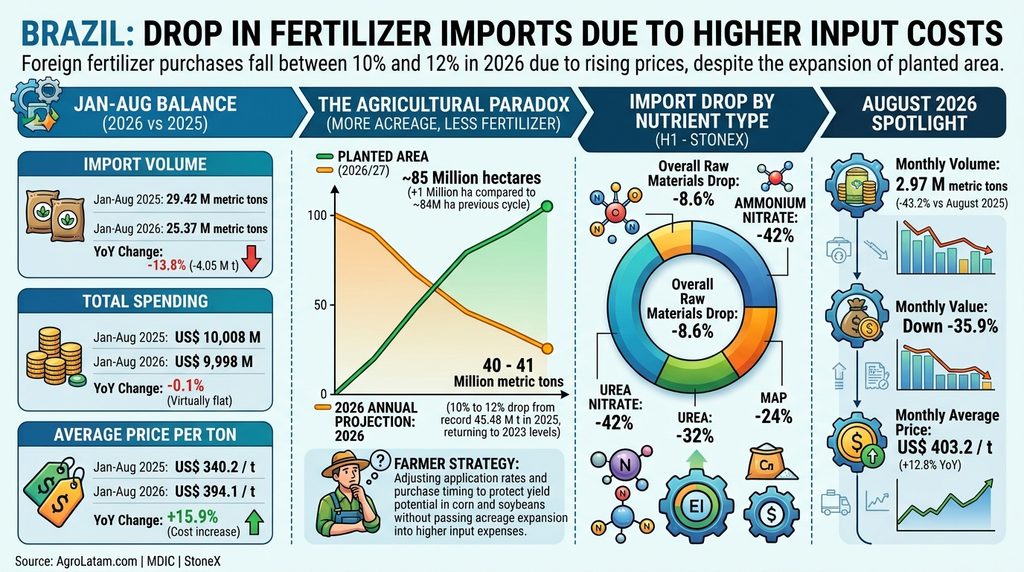
Brazil is heading toward an unusual shift in its agricultural sector: it will expand its cultivated area during the 2026/27 campaign while potentially importing between 4.5 and 5.5 million metric tons less fertilizer than in 2025. Overseas purchases are expected to close this year between 40 and 41 million tons, compared to the record high of approximately 45.5 million tons registered last year—a reduction of over 10% largely driven by rising input costs and farmers’ decisions to contain expenditure.
Available data through August shows that this adjustment is already underway. According to statistics from the Ministry of Development, Industry, Commerce and Services (MDIC), Brazil imported 25.37 million metric tons of chemical fertilizers between January and August 2026, compared to 29.42 million during the same period in 2025. This difference represents a 13.8% year-on-year drop in volume, equivalent to a decline of just over 4 million tons in only eight months.
This behavior becomes even more striking when looking at trade values. Brazil spent virtually the same amount as a year ago: USD 9.998 billion, down just 0.1% year-on-year. The explanation lies in unit costs: the average import price rose from USD 340.2 to USD 394.1 per metric ton—a 15.9% increase that helps explain why growers and agribusinesses are recalibrating their procurement strategies.
Fewer Fertilizers for an Expanding Agricultural Area
The noteworthy aspect is that the drop in import volumes does not stem from a contraction in Brazilian agriculture. Estimates for the 2026/27 campaign place total cultivated area near 85 million hectares, up from approximately 84 million in the previous cycle. Brazil could, therefore, incorporate around 1 million additional hectares while significantly curtailing its foreign fertilizer purchases.
The contrast with 2025 is substantial. Last year, Brazilian chemical fertilizer imports reached 45.48 million metric tons totaling USD 15.464 billion, according to official trade statistics. Volume had increased 2.8% compared to 2024, reaching one of the highest historical figures on record, alongside an 11% increase in average import prices.
The projected drop for this year would bring purchases back down toward levels seen in 2023, when Brazil imported roughly 41 million tons. The key difference is that agricultural acreage has continued expanding since then, heightening the need for precision management across one of the most critical cost components of grain production.
Furthermore, this adjustment is not distributed evenly across all nutrients. A StoneX survey for the first half of the year showed that imports of primary fertilizer raw materials had declined 8.6% year-on-year. Within that shift, urea purchases dropped 32%, MAP fell 24%, and ammonium nitrate plunged 42%, while other products followed different trends.
High Input Costs Force Farmers to Recalculate
The evolution of international prices stands out as one of the primary variables driving these decisions. Faced with more expensive fertilizers, farmers must evaluate application rates, purchasing timing, and product selection with greater accuracy—especially in large-scale row crops such as soybeans and corn. The overarching objective is to preserve yield potential without automatically turning acreage expansion into a proportional increase in input purchases.
For Brazil, broader market trends carry added weight due to the heavy reliance on international suppliers for its agricultural needs. Any movement in global prices, freight rates, or commercial conditions can quickly filter down to local production costs across an agricultural model that relies heavily on nutrients to sustain its scale.
August trade figures further reinforced this trend. During that month alone, 2.97 million metric tons of chemical fertilizers entered the country—a 43.2% drop compared to August 2025. Import expenditure fell 35.9%, but average prices climbed 12.8% to USD 403.2 per metric ton, according to official data.
If imports indeed land between 40 and 41 million metric tons, Brazil will close 2026 with a decline of approximately 10% to 12% compared to last year’s record. The 2026/27 campaign will thus open under a distinct set of conditions: more hectares dedicated to agricultural production, higher fertilizer prices, and a considerably lower volume of imported inputs—three variables that will prove decisive in tracking production costs and yields across Brazil’s primary crops.
Source: AgroLatam.com
Colombia Opens a New Market: Exports 2,100 Metric Tons of Sulfur for Fertilizers
Initial shipments of solid sulfur produced in Cartagena arrived in Brazil, Peru, and Tanzania, while Argentina is listed among the next prospective destinations.
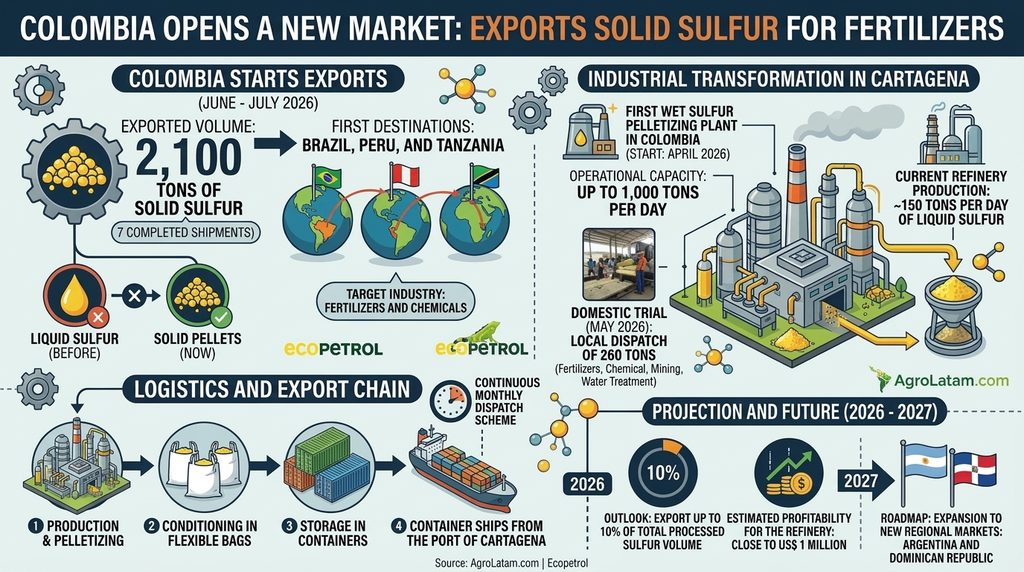
Colombia has begun exporting solid sulfur produced at the Cartagena Refinery, finalizing its first international sales with 2,100 metric tons shipped to Brazil, Peru, and Tanzania between June and July 2026. The seven shipments targeted clients across the fertilizer and chemical industries, establishing a new trade flow for a product that until recently was managed primarily in liquid form. The operation carries agricultural relevance, as sulfur serves as a key raw material in the fertilizer manufacturing chain, and Colombia now possesses the industrial capacity to commercialize it in solid format.
This transition followed the April startup of Colombia’s first wet sulfur pelletizing plant in Cartagena, featuring an operational capacity of up to 1,000 metric tons per day. The facility takes liquid sulfur generated during the refining process and converts it into solid pellets—a presentation that simplifies storage, handling, and commercialization for diverse industries and markets. Prior to initiating exports, the refinery completed its first domestic dispatch of 260 metric tons in May.
Liquid sulfur production at the Cartagena Refinery currently averages around 150 metric tons daily, according to figures released by Ecopetrol when domestic commercialization commenced. The new infrastructure expands processing capabilities for this output, catering to both domestic consumption and export demand. Key demanding sectors include fertilizers, chemicals, mining, and water treatment, thereby diversifying commercial outlets for a refinery byproduct.
From Refinery Byproduct to Fertilizer Input
The agricultural linkage stems from sulfur’s industrial applications. The new solid format allows Colombia to supply fertilizer manufacturing companies, among other clients—a sector requiring varied raw materials to formulate crop nutrition solutions. The initial international buyers are located in major South American agricultural markets, namely Brazil and Peru, as well as Tanzania in Africa.
Logistics originate inside the Cartagena Refinery, where sulfur is produced, solidified, and packaged for transport. It is then loaded into flexible intermediate bulk containers (bags), stuffed into shipping containers, and moved to the Port of Cartagena for export via container vessels. The seven initial shipments completed between June and July successfully placed the 2,100 metric tons across the three international markets.
Current export scale represents only a fraction of available capacity. For 2026, exports are projected to reach up to 10% of total sulfur produced and processed at the pelletizing facility. The commercial plan outlines a monthly schedule of international shipments, indicating that these initial 2,100 metric tons mark the start of a sustained trade pipeline rather than an isolated transaction.
From a financial standpoint, Ecopetrol estimates this activity will contribute approximately USD 1 million in profitability to the Cartagena Refinery by the close of 2026. This figure outlines an emerging business line that leverages a refining derivative to meet industrial demand. Final earnings will depend on realized trade volumes over the coming months and the ability to onboard new buyers.
Argentina Appears Among Next Target Markets for 2027
Geographic expansion already includes new target markets. For 2027, the strategy aims to extend solid sulfur sales within Latin America to reach Argentina and the Dominican Republic, broadening the network currently comprised of Brazil and Peru. If realized, Colombia will add regional buyers in markets characterized by active agricultural sectors and steady input demand.
The new industrial line underwent its initial commercial test domestically before expanding across borders. In May, shortly after plant commissioning, 260 metric tons of solid sulfur were dispatched to the domestic market to support fertilizer, chemical, mining, and water treatment applications. Export targets such as Brazil, Peru, and African nations were already identified at that stage.
The pelletizing unit’s capacity of 1,000 metric tons per day leaves room to scale operations as new buyers emerge. However, that figure reflects the facility’s processing capacity rather than the refinery’s current daily sulfur production, reported at approximately 150 metric tons per day. Distinguishing installed capacity from actual available production remains essential for accurate market projections.
With the first seven shipments completed, the next benchmark will be sales continuity. Brazil, Peru, and Tanzania have received the initial 2,100 metric tons, while Argentina and the Dominican Republic are mapped for 2027. For the fertilizer supply chain, this development introduces a new regional origin for solid sulfur; for Colombia, it transforms a refining byproduct into a new export stream serving buyers both within and beyond Latin America.
Source: AgroLatam.com
Cargill Uruguay fertilizer plant opens with 12,000 t storage to strengthen key blending hub
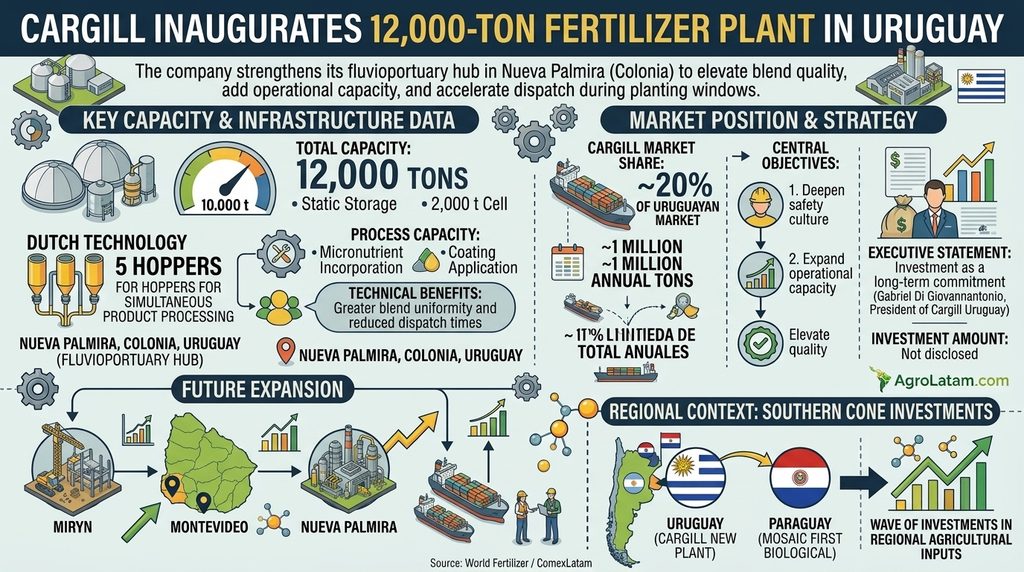
Cargill has opened a new fertilizer plant at its Nueva Palmira operation in Colonia, Uruguay, adding storage, blending and dispatch capacity at one of the country’s main river-port hubs. The Cargill Uruguay fertilizer plant has static storage of 10,000 tonnes plus a 2,000-tonne cell, for 12,000 tonnes in total, according to ComexLatam.
The facility uses Dutch technology and five hoppers that let it handle several products at once. It can add micronutrients and apply coatings to fertilizers that need them, which the company says improves blend uniformity and cuts dispatch times during tight seasonal windows.
Cargill built the plant around three goals: deepening its safety culture, expanding operating capacity to keep pace with the sector, and raising product and service quality. Gabriel Di Giovannantonio, president of Cargill Uruguay, framed the investment as part of a long-term commitment to the country’s producers. Cargill has not disclosed the investment amount.
Felipe González, who leads Cargill’s fertilizer business in Uruguay, said the company holds about 20% of a national market that moves roughly 1 million tonnes a year. Further expansions are planned at its Miryn, Montevideo and Nueva Palmira sites.
The move adds to a wave of Southern Cone crop-input investment, following Mosaic’s first Latin American biological launch in neighboring Paraguay.
Source: World Fertilizer

ARGENTINA MAIN CROPS OVERVIEW:
CORN: Commercial grain corn planting for the 2026/27 campaign reached 17.1% of the projected 8.4 million hectares (MHa), following a week-on-week progress of 6 percentage points (p.p.). This pace represents a ~5 p.p. lead compared to both the previous campaign and the last 10-year average. In East-Central Entre Ríos, planting is in its final stages with only the last early-season fields remaining, while in other active regions, operations continue smoothly. Concurrently, the 2025/26 corn harvest stands at 99.2% of the eligible national area, nearing completion. Harvest activities have finished in the northern agricultural region, while final fields in Central and Southern Buenos Aires are expected to be harvested in the coming days. Reported yields remain aligned with campaign expectations, sustaining the national production projection of 64.0 million metric tons (MTn).
SUNFLOWER: Following a week-on-week progress of 4.8 p.p., sunflower planting reached 31.4% of an area projection revised upward to 3.1 MHa for the 2026/27 cycle. This adjustment responds to a revised higher area estimate for the previous cycle and improved soil moisture reserves in the NEA region this year—particularly in Eastern Santiago del Estero—which allowed the oilseed acreage to expand beyond initial forecasts. Current planting progress is approximately 10 p.p. ahead of both the 5-year and historical averages. In terms of crop development, emergence in fields planted over recent weeks is delayed due to low temperatures and lack of rainfall, which reduced topsoil moisture levels. Meanwhile, early-planted fields in the NEA region are entering the floral budding stage.
WHEAT: Despite a week marked by frosts and localized hail events, 94.6% of the wheat area maintains a Normal-to-Excellent crop condition. Even in North-Central Córdoba and East-Central Entre Ríos—where the most severe storms were reported and damage assessments have just begun—the affected hail swaths appear to be limited in extent. Regarding the frosts that extended across the central and southern farming belts, most of the cereal is in the tillering to jointing stages, avoiding significant yield-damaging impacts. However, the need for fresh rainfall is becoming increasingly critical across parts of Córdoba, Santa Fe, Entre Ríos, La Pampa, and Northern/Western Buenos Aires, particularly as crops head into reproductive stages with rising water demand.
Source: Buenos Aires Grain Stock