
With summer crop planting underway, fertilizer demand in the Argentine market continued at a strong pace this week for both nitrogen and phosphate fertilizers.
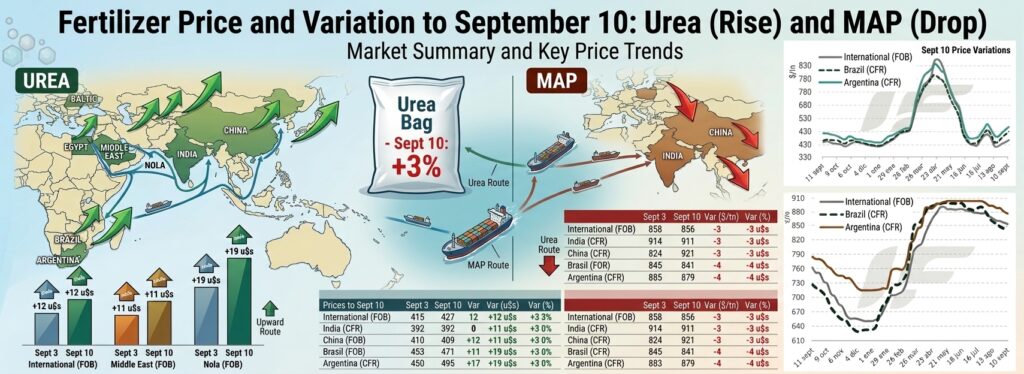
Urea was traded in the wholesale market this week at US$565–575/ton, adjusting toward the close to a minimum of US$575–580/ton, even though the CFR replacement value jumped significantly higher to settle at US$475–500/ton.
“With local urea moving barely US$10/ton this week compared to a much larger international jump, and corn maintaining firm prices, the purchasing ratio for nitrogen fertilizers remains as favorable as last week, consolidating the window of opportunity,” notes the weekly report from consulting firm IF Ingeniería en Fertilizantes.
In nitrogen fertilizers, activity showed marked dynamism this week, with deals closed toward the US$500/ton CFR mark and a very active shipment schedule for September-October 2026.
“Importers accelerated purchases due to the risk of higher increases driven by escalating tensions in the Persian Gulf and rising European gas costs; the Argentine premium over Brazil remains around US$20/ton, in line with the historical average,” the report points out.
In phosphate fertilizers, the replacement CFR dropped with no recorded deals, and phosphate values (DAP and MAP) followed with a US$10/ton drop to US$980–1005/ton in the wholesale market (bulk loaded on truck at port). These values align with import parity.
“In phosphate fertilizers, the market is in a virtual commercial standstill with no full cargoes confirmed this week, while the replacement CFR in Argentina and Uruguay yields to US$870–875/ton for DAP and US$880–885/ton for MAP, with a premium over Brazil widening to more than US$30/ton,” it indicates.
In the international nitrogen fertilizer market, the upward surge accelerated this week, driven mainly by the strength of Western markets.
“This ‘rally’ finds its foundations in the intensification of geopolitical conflicts in the Middle East (which continue to restrict normal flows through the Strait of Hormuz and the Red Sea) and in the drastic increase in natural gas costs in Europe,” the document explains.
Meanwhile, the global phosphate market is characterized by a moderate dynamic of widespread caution and mild downward pressure in major consumption hubs.
“Buyers in South Asia (India and Bangladesh) managed to negotiate lower import prices in their tenders. At the same time, persistent uncertainty regarding China’s export policy continues to limit global availability. In the Western Hemisphere, physical demand remains sluggish amid high port inventories in Brazil and stagnant spot purchases in South America,” it stresses.
Source: Valor Soja
ARGENTINE: Bahía Blanca Could Lead South American Urea Production
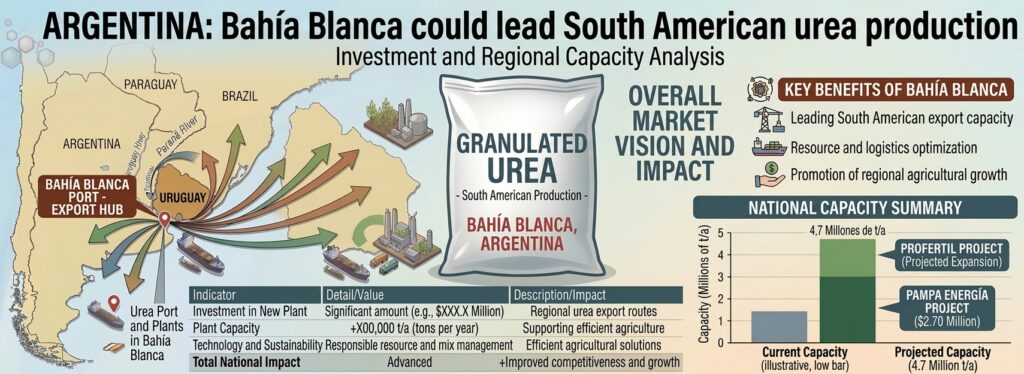
The US$2.7 billion investment approved for Pampa Energía and the expansion projected by Profertil would raise national capacity to 4.7 million tons per year.
Argentina could fully cover its demand for this fertilizer, replace foreign purchases, and generate a significant exportable surplus if the projects planned for the coming years materialize. According to an analysis conducted by the Bahia Blanca Grain and Products Exchange, this development would also transform the country into South America’s leading producer.
The most advanced initiative contemplates the construction of a plant with a production capacity of 2.1 million tons per year. The facility would begin operating by late 2029 and be located in the industrial complex in Ingeniero White.
To that outlay—recently incorporated into the Incentive Regime for Large Investments (RIGI)—Profertil’s expansion plan could be added. The company is analyzing doubling its current volume to reach 2.6 million tons annually.
Import Dependence: In Argentina, consumption averaged 1.8 million tons per year between 2015 and 2025, while local production stood at a little over one million, using Profertil’s sales as a baseline. The difference forced the import of around 742,000 tons per year over the last decade. That need deepened in 2025, when domestic utilization reached 2.4 million tons, the highest record since 2002, according to data from CIAFA.
INDEC statistics show an even greater dependence, as an average of 857,116 tons entered annually between 2015 and 2025, operations that caused an accumulated foreign exchange outflow close to US$3.9 billion. In 2025 alone, 1.5 million tons were acquired abroad, the second largest volume since the series began in 2002.
With Profertil’s current capacity and the new factory promoted by Pampa Energía, Argentine supply would reach 3.4 million tons in 2029. Taking 2024 consumption as a reference—estimated at 2.3 million tons—and foreign purchases of just over one million, import substitution would represent savings of approximately US$507 million, while exports could contribute another US$521 million.
The scenario would have an even greater scope if Profertil’s expansion moves forward. In that case, the surplus available for export would hover around 2.4 million tons—an amount equivalent to the entire national demand registered in 2025—with potential revenue close to US$1.137 billion.
Gas and Strategic Location: The project possesses a decisive advantage in the supply of natural gas, the main feedstock used to manufacture urea. The Neuba I and II pipelines connect the Neuquén Basin—particularly the Loma La Lata and Sierra Barrosa fields—with Bahía Blanca.
Energy availability, industrial infrastructure, and proximity to port facilities form a favorable combination to serve both the Argentine market and other South American destinations. This outlook takes on special relevance amid geopolitical conflicts affecting international fertilizer trade and putting pressure on agricultural costs.
If the announced investments materialize, Argentina could not only reduce its exposure to these external disruptions, but also turn a historically deficit product into a new source of exports, while Bahía Blanca consolidates itself as a regional hub for manufacturing, distribution, and supply.
Source: Bahía Blanca Grain and Products Exchange
URUGUAY: Cargill inaugurates new Nueva Palmira fertilizer plant
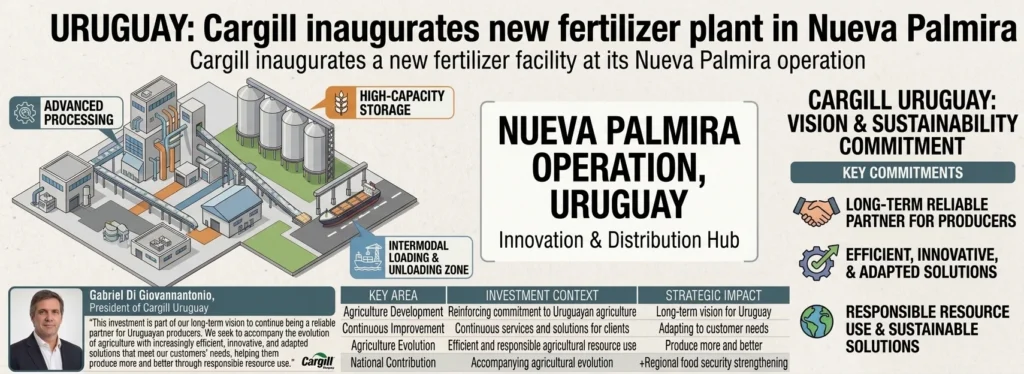
Cargill inaugurated a new fertilizer plant at its Nueva Palmira operation, an investment that reinforces its commitment to the development of Uruguayan agriculture and to the continuous improvement of the services and solutions it offers to its customers, accompanying the evolution of an increasingly efficient agriculture oriented to the responsible use of resources.
“This investment is part of our long-term vision to continue being a reliable partner for Uruguayan producers. We seek to accompany the evolution of agriculture with increasingly efficient, innovative solutions adapted to the needs of our customers, helping them to produce more and better using resources responsibly,” said Gabriel Di Giovannantonio, President of Cargill Uruguay.
The new facility was conceived based on three central objectives: to deepen the safety culture, expand the operational capacity to accompany the growth of the sector, and raise the quality standards of the products and services that the company provides to producers.
In terms of safety, the investment incorporates improvements in infrastructure, processes and technology aimed at strengthening an increasingly safe, efficient, and reliable operation. Likewise, the new operational capacity will optimise the processes of preparation and dispatch of fertilizers, contributing to respond with greater agility to the needs of customers in a production context where application windows are increasingly demanding.
The plant also incorporates new capabilities to develop more precise mixtures and expand the offer of plant nutrition solutions, including micronutrients and technologies that allow recommendations to be adapted to the specific needs of each crop and production system, contributing to an increasingly efficient agriculture in the use of resources.
“Agriculture is evolving towards increasingly precise and efficient systems. This investment allows us to accompany this transformation with greater service capacity, more precise mixtures and new plant nutrition tools that help producers optimise the use of resources and maximise the potential of their crops,” commented Felipe González, Crop Inputs Product Line Manager at Cargill Uruguay.
The inauguration was held within the framework of a meeting with customers and producers, which included a presentation on the trends and prospects of the international fertilizer market by Zacarías Ruiz Moreno, Director of Fertilizers of Ag & Trading Latam, and a technical talk on protectors and micronutrients given by Eng. Agr. Federico Pieroni, from ProNutrition. In addition, attendees toured the facilities to learn about the improvements incorporated into the operation.
With this initiative, Cargill continues to invest in strengthening its operations in Uruguay, seeking to provide greater value to its customers through innovative solutions, operational efficiency and proximity to the producer, contributing to the development of an increasingly productive and sustainable agriculture.
Source: World Fertilizer
BRASIL: Los fertilizantes se BRASIL: Fertilizers become more affordable for farmers in August.
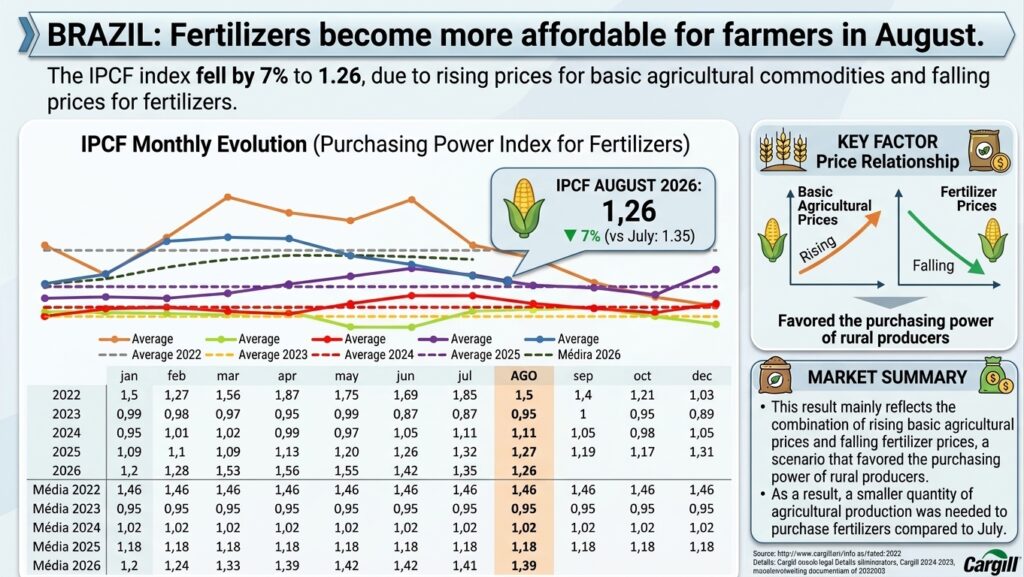
IPCF fell 7% to 1,26, driven by higher agricultural commodity prices and lower fertilizer prices.
The Fertilizer Purchasing Power Index (IPCF) closed August at 1,26, down 7% compared to the previous month (1,35). This result mainly reflects the combination of rising agricultural commodity prices and lower fertilizer prices, a scenario that favored the purchasing power of rural producers. As a result, a smaller quantity of agricultural production was needed to purchase fertilizers compared to July.
During the same period, the dollar remained virtually stable, with a slight appreciation of around 1%, exerting limited influence on the index’s performance.
Among the factors that contributed to the result is the average 6% increase in agricultural commodity prices. During the period, soybeans rose 5%, corn increased 4%, cotton rose 1%, and sugarcane appreciated by 8%.
Market behavior was influenced, among other factors, by expectations surrounding the North American soybean and corn harvest, as well as weather conditions observed in important producing regions. Uncertainties related to the potential impacts of El Niño on the next Brazilian harvest also contributed to supporting agricultural prices.
Despite the improvement observed in the IPCF, external factors continue to demand market attention. The geopolitical scenario in the Middle East continues to be monitored due to its relevance to the global fertilizer supply chain, especially given the region’s logistical and commercial importance.
At the same time, the effects of El Niño remain on the radar, given its potential to influence planting and crop development in the next harvest.
Source: Cultivar Magazine

ARGENTINE MAIN CROPS OVERVIEW
CORN: Commercial grain corn planting for the 2026/27 season has reached 5.5% of the projected 8.4 million hectares. Following a week-over-week progress of 4 percentage points, field operations are advancing primarily across Center-North Santa Fe, the Northern Core, and Center-East Entre Ríos. Conversely, planting is progressing at an incipient stage in the Southern Core, where low soil temperatures could delay crop emergence. Nationally, planting progress is 1.7 percentage points ahead of the previous campaign. Meanwhile, the 2025/26 corn harvest stands at 96.9% of the suitable area and is entering its final stretch, though it still lags behind year-over-year by 3.1 percentage points. Reported yields continue to align with seasonal expectations, allowing us to maintain our national production projection at 64 million metric tons.
SUNFLOWER: Sunflower planting covers 23.4% of the projected 3 million hectares for the 2026/27 cycle, following a week-over-week advance of 4.1 percentage points. Progress is concentrated mainly in the northern and central farming regions, led by Center-North Santa Fe, where field operations accelerated to reach 50% of its projected area, favored by the absence of rain over the past week. In the NEA (Northeast) region, planting covers 94% of the intended area, while in Santiago del Estero, field operations remain on hold awaiting fresh rainfall. Towards the southern agricultural footprint, planting has not yet commenced.
WHEAT: Finally, regarding wheat, crop phenology continues to advance nationwide, with 53% in full tillering and 41% in stem elongation. The Northwest (NOA) and Northeast (NEA) regions exhibit the most advanced phenological development amid a warm winter with few chilling hours, raising uncertainty over expected yields. Adequate to Optimal soil moisture conditions persist across 89% of the planted area, while crop condition improved by 2 percentage points over the same period, reaching 95.9% in Normal to Excellent condition. Across both Core regions, the cereal is progressing from tillering to stem elongation, with the most advanced fields approaching the flag leaf stage under good water availability. Towards the south, development is slower, with fields in full tillering and optimal profile moisture. Frosts were recorded across both regions in recent days, while preventative fungicide applications are becoming widespread, primarily targeting yellow spot and rust.
Source: Buenos Aires Grain Exchange