
The nitrogen shortage in the United States triggers a regional relief signal, even though flows, currencies and demand will define its arrival at the producer.
Minor fertilizer prices in the United States will fall again during the second full week of July 2026, with strong monthly drops in UAN32, anhydrous ammonia, urea and UAN28. The movement was registered among American agricultural distributors and is important for Latin America because it can anticipate changes in international replacement values. However, it does not represent a direct reduction for producers in Brazil, Argentina, Paraguay, Uruguay, Mexico or other regional markets.
The adjustment is headed by UAN32, whose average was down 15% compared to the previous month, up to US$ 465 per ton cut. Anhydrous ammonia dropped 11%, to US$967, and was sold for less than US$1,000 for the first time in 17 weeks. The urea also went back, with a drop of 7% to US$ 682, and UAN28, which lost 6% and stood at US$ 480. For the producer, the correction could be converted into a purchase opportunity, although its scope will depend on the moment and the local market.
The American signal is relevant because fertilizers are negotiated within a very connected global chain. Latin America depends to a large extent on imports of nitrogenous, phosphate and potassium nutrients, which is why low sustainability in the main markets can reduce the replacement cost of importers and distributors. This transfer is not automatic: regional values include sea and land shipping, port costs, commercial margins, shipping, credit availability and exchange rate variations.
For corn, wheat, rice, sugarcane and other nitrogen-intensive crops, an effective reduction in fertilizers could alleviate the assumptions for the 2026/27 campaign. Inputs continue to occupy an important part of the direct cost and condition the applied doses, the planned decisions and the expected margins. In this context, a lower urea or UAN can improve the input-product relationship, especially where grain prices do not compensate for the increase in financial, logistical and rental costs.
However, the interannual comparison maintains a warning. The other analyzed products remain above their July 2025 levels. Anhydrous ammonia records an annual increase of 26%; el UAN28, 15%; el MAP, 13%; y el DAP, 12%. The 10-34-0 and the UAN32 rose by 7%, the urea 4% and the potassium 3%. The recent decline represents monthly relief, but does not imply a return to a low-cost structure for the agricultural producer.
The values per unit of nitrogen also show differences that can guide fertilization strategies. Urea averaged US$0.74 per pound of nitrogen; anhydrous ammonia, US$0.59; el UAN28, US$0.86; y el UAN32, US$0.73. These relationships must be evaluated along with the costs of application, storage, logistics, volatility and availability of equipment. For cooperatives, advisors and producers, comparing the cost of the nutrient actually used is more useful than looking solely at the price per ton.
The international scenario could still change the trend. A support program for the purchase of nitrogen fertilizers in France boosted European demand for urea and UAN solutions, which could compete for some available volumes. This includes natural gas prices, commercial restrictions, geopolitical conflicts and the export capacity of the main suppliers. A recovery in global demand could stop the economy before it completely moves to Latin America.
For regional buyers, the US data works as an early reference and not as a local quotation. The most prudent strategy will be to follow import prices, the type of exchange rate and distributor offers, in addition to evaluating staggered purchases. The correction improves expectations, but each country has a different commercial structure. The real relief will come when the international base reaches the price set in the field and concretely reduces the cost per hectarea.
Source: © AgroLatam
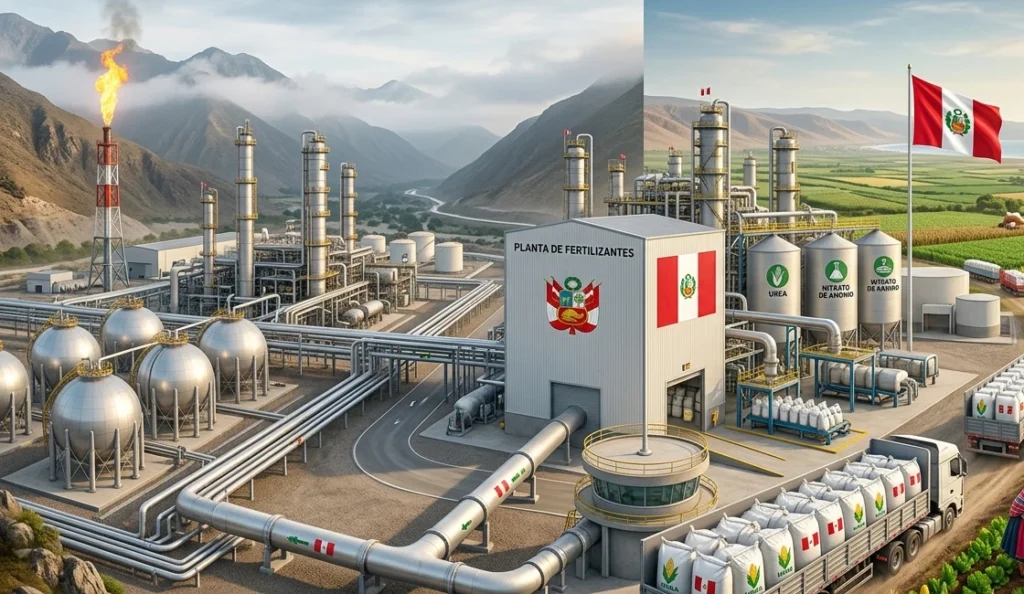
Peru prepares a move for agriculture: producing fertilizers with its own gas
The Government has enabled an area of Piura to install a petrochemical complex that would transform natural gas into fertilizers for Peruvian agriculture.
The Ministry of Energy and Mines of Peru (Minem) declared the province of Paita, in the Piura region, as a Determined Geographic Zone for the installation of a Decentralized Petrochemical Development Complex. The decision, made official in July 2026, enables the advancement of a project that could produce fertilizers with Peruvian natural gas, reduce external purchases and modify the cost structure of the agricultural sector.
The measure was approved through Ministerial Resolution No. 278-2026-MINEM/DM. The document establishes that Paita has adequate technical, energetic, logistical and territorial conditions to receive an industrial investment of these characteristics.
The declaration does not mean that the plant is built and that it has started manufacturing fertilizers. It represents the official recognition of the location from which the complex can be developed and allows progress with the following technical, environmental, financial and administrative steps.
The regional governor of Piura, Luis Neyra León, stated that the initiative would allow for added value to natural gas extracted in northern Peru. Instead of solely commercializing the energy resource, the proposal contemplates using it as a raw material for an industrial chain directly linked to agriculture.
Peruvian urea to reduce costly dependence
The future complex could produce urea, ammonium nitrate and ammonium sulfate, three fertilizers used to provide nitrogen to crops. Peru currently depends on international suppliers to cover a large part of its demand, a situation that exposes farmers to price variations, logistical problems and commercial restrictions.
The war between Russia and Ukraine showed the effects of this dependence. The conflict altered world supply, made fertilizers more expensive and made access to inputs difficult in many importing countries. In Peru, the increase affected the production costs of thousands of farmers and especially affected those who work with reduced financial margins.
Manufacturing fertilizers within the country would make it possible to make use of available gas, reduce exposure to external interruptions and have a more predictable supply. However, the final price will depend on the investment, the production scale, the energy costs and the commercialization conditions that adopt the project.
The Piura Regional Government requested Minem and the promoting company that future operations include mechanisms to facilitate access for Peruvian producers. The intention is that industrial investment is not limited to supplying the market, but that it can offer competitive commercial conditions for the field.
The availability of national fertilizers could benefit nutrient-intensive crops and reduce part of the uncertainty that producers face before each campaign. It would also provide a local price reference against international quotations and import costs.
Paita brings together gas, port and logistical capacity: Paita’s election responds to its surroundings with the production of natural gas in the north, its port infrastructure and its connection with commercial corridors. These characteristics facilitate the intake of equipment, the construction of the plant and the subsequent distribution of products across different agricultural regions.
Neyra highlighted that the proposal is promoted by the natural gas production company itself. This participation could simplify access to raw materials and provide greater continuity of supply, one of the central factors for the operation of a petrochemical plant.
Therefore, the project must complete studies, permits and economic definitions before reaching the construction phase. It will also be necessary to know the predicted capacity, the investment amount, the execution plans and the committed gas volume, data that will determine its real reach.
In addition to manufacturing fertilizers, the complex could attract industrial suppliers, logistical services and companies linked to energy. The construction stage would require manpower and equipment, while the operation would require technical personnel and specialized services.
The resolution opens up an industrial possibility for Piura, but its impact on agriculture will depend on whether the plant is concrete and can offer fertilizers under accessible conditions. The next step will be to convert the territorial qualification into a project with financing, a work schedule and verifiable production commitments.
Source: AgroLatam.com

Urea prices rise 14% at Brazilian ports in four weeks.
Urea prices at Brazilian ports have risen 14% in the last four weeks, reflecting escalating tensions in the Middle East and growing concerns about the global supply of nitrogen fertilizers. This assessment comes from StoneX, which warns of potential impacts on fertilizer purchases for the next harvest.
According to Tomás Pernías, Market Intelligence analyst at the consulting firm, the upward trend is driven by logistical restrictions related to navigation difficulties in the Strait of Hormuz and the United States’ blockade of Iranian ports, factors that reinforce the perception of lower product availability in the international market.
On the demand side, the period also favors price increases. Brazil usually increases its purchases of nitrogen fertilizers at this time of year, while India remains active in the international market to replenish stocks, increasing competition for available cargoes.
According to StoneX, the resumption of the upward trend comes after a short period of price relief, supported by expectations of progress in negotiations between the United States and Iran and a gradual normalization of navigation through the Strait of Hormuz. With the new escalation of tensions, these prospects have lost strength.
The consultancy notes that the scenario deserves attention because the coming months concentrate the main window for fertilizer acquisition for the 2026/27 crop. Furthermore, the volumes of urea, ammonium sulfate, and ammonium nitrate imported by Brazil between January and June indicate nitrogen stocks below the levels recorded in previous years, which may require a faster pace of purchases in the coming weeks.
Despite the recent increase in urea prices, Pernías states that the exchange rates between corn and fertilizer remain close to the historical average, indicating that, for now, the impact on producers is still limited. In the phosphate market, however, the scenario is less favorable, with pressured exchange rates, which continues to affect the profitability of agricultural production.
Source: Cultivar Magazine

China extends phosphate export curbs through August 2026 as Russia holds fertilizer quotas
China has extended restrictions on exports of key phosphate fertilizers at least through August 2026, while Russia continues to enforce quantitative limits on outbound fertilizer shipments, creating overlapping supply constraints for import-dependent buyers worldwide.
The China phosphate export restrictions cover DAP, MAP and certain NPK formulations, with ammonium sulfate remaining relatively less restricted. Beijing first imposed export curbs in mid-March 2026 to protect domestic supply after the Strait of Hormuz crisis disrupted global trade. Between 50% and 80% of China’s fertilizer export volumes are now restricted, according to Reuters analysis of Chinese customs data. Russia’s quota system, operating through the Eurasian Economic Union framework, similarly limits available spot volumes of nitrogen and phosphate products.
The combined effect is reshaping global fertilizer trade flows. Import-dependent regions including India, Brazil, Southeast Asia and sub-Saharan Africa are being forced to source more product from alternative suppliers such as Morocco’s OCP, North American producers and Middle Eastern exporters — often at higher freight and product costs. China supplied roughly one-fifth of fertilizer imports for Brazil, Indonesia and Thailand last year, rising to one-third for Malaysia and New Zealand, according to International Trade Centre data.
Source: Commodity Board.

ARGENTINA MAIN CROPS OVERVIEW:
SUNFLOWER: Started the sunflower crop with a national increase of 4.4% of a projected area of 3 MHa, surpassing the previous cycle by 5.3%. This progress is concentrated exclusively in the NEA, which accounts for 23.6% of the projected surface area for the region. In the center of the agricultural area, the beginning of the work is waiting for the increase in temperatures, while, in the south, it is often difficult to start the wind, the current condition of the lots and the wet year’s prospects are uncertain regarding the planning of the work.
WHEAT: With inter-weekly soil progress of 0.7 percentage points, the wheat stock covers 98.4% of the projected 6.5 MHa. This incipient progress of labor is due to difficulties in the entry of machinery into the south of the agricultural area, fundamentally in the Southeast of Buenos Aires, where the high environmental humidity and saturation of soils impede the normal progress of labor and generate uncertainty regarding the completion of the construction plans. However, in the rest of the agricultural area, the good water supply supports the growth and development of the cereal, maintaining a normal to excellent cultivation condition in 99.7% of the land area.
CORN: On the other hand, the corn harvest with commercial grain destination reached 69.8% of the suitable area at national level, with an average yield of 79.4 qq/Ha. The main condition for progress continues to be concentrated in the southeast of Bonaventure, where the persistence of high environmental humidity slows down the drying of grains, preventing them from reaching levels suitable for harvesting. As a result, the work maintains an important delay compared to the usual pace for this time of year. In the north, health records continue to record the presence of Dalbulus maidis. According to collaborators in the region, the incidence of the plague has been higher than predicted and its impact on performance will begin to become evident as the harvest progresses. On the other hand, as late crops are incorporated into the harvest in different regions of the agricultural area, particularly in both Nuclei and the North of La Pampa-West of Buenos Aires, the relevant yields continue in line with the expectations of the campaign, which allows sustaining a national production projection of 64 MTn.
SORGHUM: Finally, the harvest of grain sorghum reached 90.3% of the suitable area at national level, with an average yield of 41.4 qq/Ha. Si bien el Centro-Norte de Córdoba continúa recording the highest yields of the campaign, with an average of 56.5 qq/Ha, the advance of collection over the rest of the agricultural area yields lower yields than expected, adjusting to the lower national average. In this context, we reduced our production budget by 100 mTn, dropping the total to 2.8 Mtn.
Source: Buenos Aires Grain Exchange