
International prices for phosphate fertilizers have begun to decline (though they remain expensive in historical terms). Not-so-good news: Prices for nitrogen fertilizers have started to pick up again.
Phosphate fertilizer producers continue to deal with extremely tight profit margins due to elevated sulfur prices. Against this backdrop, Lifosa’s plant in Lithuania has completely halted its phosphate production.
Saudi company Ma’aden managed to sell a spot shipment of diammonium phosphate (DAP) to Bangladesh at $920 USD/ton FOB departing via the Red Sea.
“Due to high freight rates and war risks in the Suez Canal, Ma’aden agreed to load its next formula DAP volume bound for India from ports in Oman, reducing exposure to the conflict,” notes the weekly report from the consultancy IF Ingeniería en Fertilizantes.
Facing a complete lack of spot purchasing activity in Brazil, Moroccan corporation OCP began diverting uncommitted spot tons of DAP and MAP (monoammonium phosphate) toward destinations with more attractive margins, such as the U.S. and Western Europe.
In India, National Fertilizers Limited (NFL) awarded a tender for 60,000 tons of Egyptian-origin DAP at a price of $928 USD/ton CFR with credit facilities for shipment this month (August). Additionally, IPL closed an import deal for South Korean DAP at $955 USD/ton CFR for September arrival.
“In Bangladesh, the week’s government tender for private DAP and TSP (triple superphosphate) imports closed with a volume of bids that far exceeded buying demand. Global producers submitted massive offers, attracted by the more competitive price premiums in this destination compared to depressed markets like Brazil,” the report highlights.
In the Argentine market, import activity for phosphate fertilizers remains paralyzed, and the reference CFR price for DAP and MAP dropped to $880–$900 USD/ton, dragged down by Brazil’s weakness and seasonal calm ahead of the September coarse-grain planting. In the wholesale market, phosphates showed no changes: DAP stayed in the $990 to $1,010 USD/ton range, and MAP between $1,020 and $1,040 USD/ton loaded on trucks at port.
“Despite this general paralysis, improved affordability ratios of grain relative to fertilizer spurred increased interest in lower replacement-cost substitutes, such as superphosphates,” the report indicates.
Regarding the global nitrogen market, this week experienced a strong resurgence and a broad price rebound.
“Egyptian exporters, backed by renewed buying interest from Europe, managed to place granular urea in the $455 to $480 USD/ton FOB range (with specific deals closed at $475 USD/ton FOB). In Algeria, granular product was sold in the $460 to $470 USD/ton FOB band,” it remarks.
“Chinese prilled urea continued to dominate shipments to India following the tender, with its export quote assessed at $355–$365 USD/ton FOB,” it adds.
In the ammonium sulfate (AMSUL) market, standard-grade FOB prices recovered mid-week to $175–$190 USD/ton FOB, tracking the rebound in urea. “Producers in southern China reported having virtually no available inventory for export under customs inspection. Sales of standard AMSUL were finalized for delivery this coming September to Brazil at $180 USD/ton FOB, and to other South American nations at $185 USD/ton FOB.”
In the Persian Gulf, granular urea FOB quotes stabilized, with offers assessed between $390 and $408 USD/ton FOB. “Logistical and production disruptions stemming from the conflict with Iran continue to critically strip between 4.0 and 4.5 million tons of urea from the global export market.”
Brazilian buyers, who had been pushing for values near $400 USD/ton CFR early in the week, were forced to accept higher prices in the face of international firmness.
“The range for granular urea in Brazil climbed from $410–$420 USD/ton CFR early in the week to $430–$440 USD/ton CFR by the report’s close, with non-Chinese offers exceeding that level. In tandem, compacted ammonium sulfate in Brazil appreciated firmly to $210–$230 USD/ton CFR,” the document notes.
Granular urea barges at the port of NOLA (U.S.) reversed their downward trend mid-week, recovering to values between $390 and $405 USD/ton FOB.
In Argentina, the nitrogen market showed a strong resurgence this week. “After hitting a floor of $430 USD/ton CFR early in the week, urea bounced back sharply to close at $460–$470 USD/ton CFR, in line with Brazil’s strength,” the report explains.
“Import demand remained active, with steady inquiries for lots of 5,000 to 10,000 tons, though without officially confirmed large-volume deals,” it adds.
The recovery in corn and wheat prices, combined with the external bounce in nitrogen, triggered inquiries and limited-volume trades.
“The underlying constraint has not changed: with wheat planting virtually wrapped up and corn planting still several weeks away, there is no logistical demand driving large-scale operations, and local business remains restricted to small lots,” it clarifies.
In the Argentine wholesale market, urea hit a floor of $555 USD/ton early in the week before recovering to close at $565–$570 USD/ton.
Source: Valor Soja
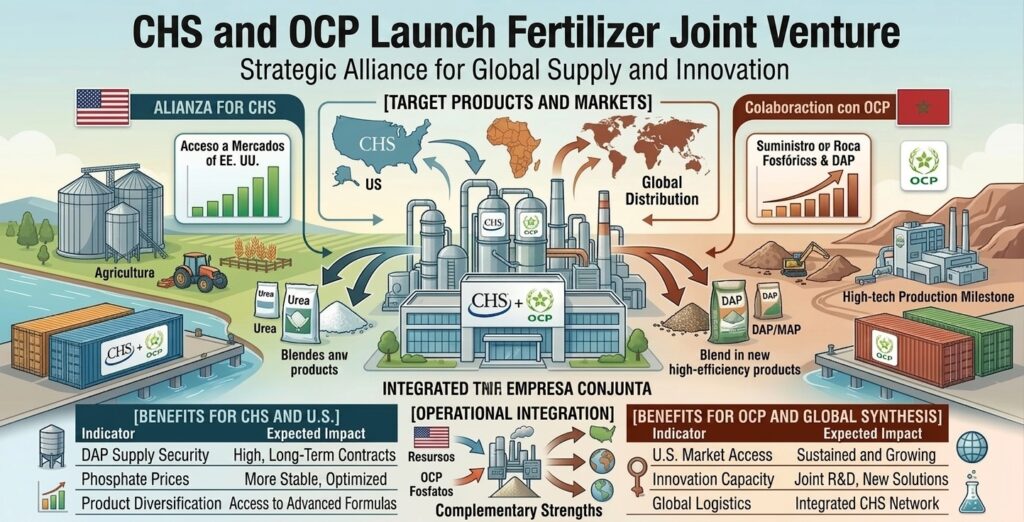
CHS, OCP launch fertilizer joint venture
CHS, farmer-owned cooperative, and OCP North America, a subsidiary of the OCP Group, are preparing to build and operate a phosphate fertilizer production facility at the Cornerstone Energy Park in Waggaman, Louisiana, US, through a proposed joint venture.
The new plant is expected to produce over 1 million tonnes of phosphate-based fertilizer annually and would be the first of its kind constructed in the United States since 1984, the companies said.
US farmers use phosphate fertilizer to aid in crop production, but phosphate reserves in the country are declining. Today, the United States imports approximately 40% of the phosphate-based fertilizer used by farmers. The potential to bring this new capacity online could reduce US dependency on imported phosphate-based fertilizer by more than 48%, significantly strengthening the domestic fertilizer supply chain, the companies noted.
“This is an exciting moment for American agriculture,” said Jay Debertin, president and chief executive officer of CHS. “As a farmer-owned cooperative, we exist to help farmers succeed. Together with OCP North America, we have the opportunity to build the first phosphate fertilizer plant in the US in more than 40 years. This investment has the potential to create more value for our owners by bringing fertilizer production closer to the American farmer and the cooperative network.”
In connection with the proposed joint venture, the OCP Group will supply phosphoric acid to the facility, drawing on its global phosphate expertise and resources. Finished fertilizer products will be distributed through both OCP North America and CHS, which serves cooperatives, retailers and farmers across the United States through its extensive wholesale and retail crop nutrients network.
The new fertilizer plant’s expected location within the Cornerstone Energy Park in Waggaman will ensure access to raw materials and the ability to transport products via the Mississippi River system, the companies said.
“This project represents a milestone in OCP North America’s commitment to serving American agriculture,” said Kevin Kimm, CEO of OCP North America. “Together with CHS, we aim to build lasting infrastructure that strengthens US food security and delivers a reliable, domestically produced supply of the crop nutrients American farmers need.”
Once approved, the project is expected to create approximately 60 permanent jobs in Jefferson Parish along with 500 construction jobs. Subject to project-related and funding approvals, construction is expected to take up to 24 months. The companies said an application has been submitted for potential funding through the US Department of Agriculture’s Fertilizer Investment & Expansion for Long-term Domestic Supply program.
CHS, a global agribusiness and the largest farmer-owned cooperative in the United States, operates diversified agronomy, grains, foods and energy businesses with revenues of $35.5 billion in fiscal year 2025.
Source: WolrdGrain Mg.
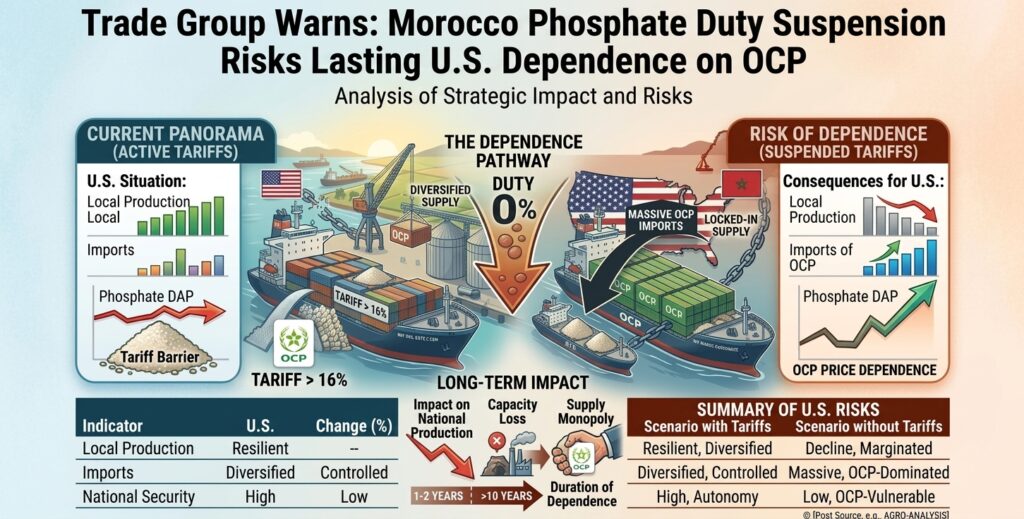
Trade group warns Morocco phosphate duty suspension risks lasting U.S. dependence on OCP
The Coalition for a Prosperous America has urged the Trump administration to allow the temporary duty-free window for Moroccan phosphate fertilizer imports to expire on schedule, arguing that permanent relief would rebuild U.S. dependence on OCP, Morocco’s state-owned phosphate monopoly. The trade group’s August analysis cited the Commerce Department’s July 2026 preliminary sunset review, which found that revoking the countervailing duty order would likely mean renewed subsidization at a rate of 20.04% — the highest finding in the order’s five-year history.
President Trump declared a national emergency over fertilizer supplies on June 29 and signed a proclamation suspending countervailing duties on Moroccan phosphate imports for up to eight months. The action followed years of lobbying by farm groups who argued the duties, first imposed in 2021 after Florida-based Mosaic alleged that OCP benefited from unlawful government subsidies, added billions of dollars to U.S. farm input costs.
The Coalition countered that U.S. phosphate was already the cheapest major benchmark globally even with duties in effect, because the binding constraint on prices is global sulfur supply disruptions rather than tariff policy. OCP controls approximately 70% of the world’s known phosphate reserves and holds a 31% share of the global phosphate market. The June 29 duty suspension remains in effect through at least February 2027.
Source: Coalition for a Prosperous America
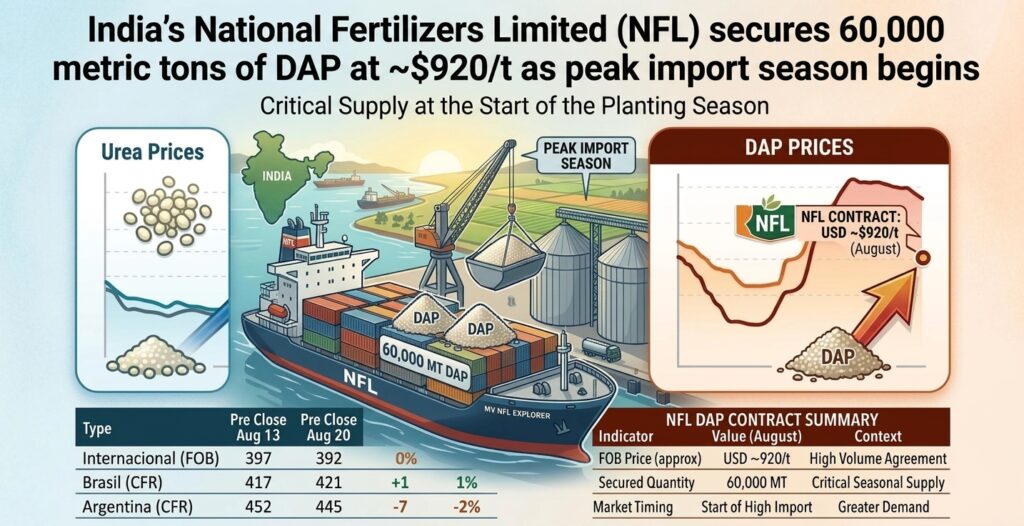
India’s NFL secures 60,000 metric tons of DAP at $920s/t as peak import season begins
Indian fertilizer importer National Fertilizers Limited (NFL) has likely purchased two 30,000 metric ton cargoes of DAP from trading firm Midgulf International at prices in the high $920s per metric ton CFR with credit, equivalent to the mid-$910s per metric ton on a sight basis, according to Argus Media.
The India NFL DAP tender closed on August 11 and attracted four offers from trading firms Ameropa, Oasis Global, Agrifields, and Midgulf. NFL requested shipment of the cargoes to India’s west coast by August 31. The sale could not be confirmed with Midgulf, and the origin of the DAP cargoes remains unknown.
Separately, fellow Indian importer FACT closed its own tender for 50,000 metric tons of DAP on August 18, a day after delaying the original deadline. FACT received four offers: Morocco’s OCP offered Moroccan-origin DAP, VB Venture offered U.S.-origin DAP, Oasis Global offered Russian-origin DAP, and Ameropa offered open-origin DAP. Delivery was requested to New Mangalore or Tuticorin ports.
The procurement activity signals that India is entering its peak import season ahead of the October–March rabi planting window. Indian importers face tight global phosphate availability as China’s export restrictions on DAP, MAP, and select NPK blends remain in place through August, covering an estimated 50–80% of Chinese export volumes.
Source: Argus Media

ARGENTINA MAIN CROPS OVERVIEW
SUNFLOWER: As of this report, sunflower planting covers 16.7% of the projected 3 Mha for the 2026/27 campaign, following a week-on-week progress of 2.6 percentage points. Although field operations slowed down following rainfall in the NEA region, current national progress leads by 3.8 and 5.4 p.p. compared to the 5-year and historical averages, respectively. Meanwhile, while planted and emerged fields are achieving homogeneous stands, the absence of rainfall over recent weeks in the southern agricultural area is allowing for a gradual recovery of topsoil conditions ahead of planting operations set to begin within the next month and a half.
WHEAT: Wheat planting has officially concluded, reaching the estimated 6.5 Mha for the current cycle, despite reports of isolated unplanted fields in the southern agricultural region that will not alter the current projection. The lack of suitable soil conditions constrained opportunities to expand cereal acreage throughout the entire planting window; however, soil moisture reserves continue to boost yield expectations. Currently, following a notable recovery in soil moisture—now rated Adequate/Optimal across 90.8% of the area—76.4% of the cereal is progressing through tillering and beyond, with the earliest fields in the NOA (Northwest) already entering grain filling.
CORN: Commercial corn harvesting reached 88% of the national suitable area, with an average yield of 78 q/ha (7.8 t/ha). Following several days of favorable environmental conditions, harvesting operations gained momentum, recording a weekly progress of 6.7 p.p. and allowing machinery to advance over fields previously delayed by high moisture content. Despite this improvement, harvest progress trails by 9.2 p.p. compared to the previous season, with unharvested areas concentrated primarily in the southern agricultural region—specifically Southwestern Buenos Aires-Southern La Pampa and Southeastern Buenos Aires. On the other hand, recorded yields remain in line with seasonal expectations, sustaining our national production forecast at 64 MT.
SORGHUM: Grain sorghum harvesting has officially concluded nationwide, although a few scattered fields remain to be harvested without altering the current production estimate. The national average yield settled at 40.7 q/ha (4.07 t/ha), compared to a 5-year average harvested yield of 35.4 q/ha. Regarding regional performance, notable yields were achieved in Center-North of Córdoba at 56.5 q/ha, followed by the Southern Core and Northern Core regions at 53.9 and 53.3 q/ha, respectively. In this context, supported by an average yield exceeding the 5-year average, national production for the campaign is estimated at 2.8 MT.
Source: Buenos Aires Grain Exchange