
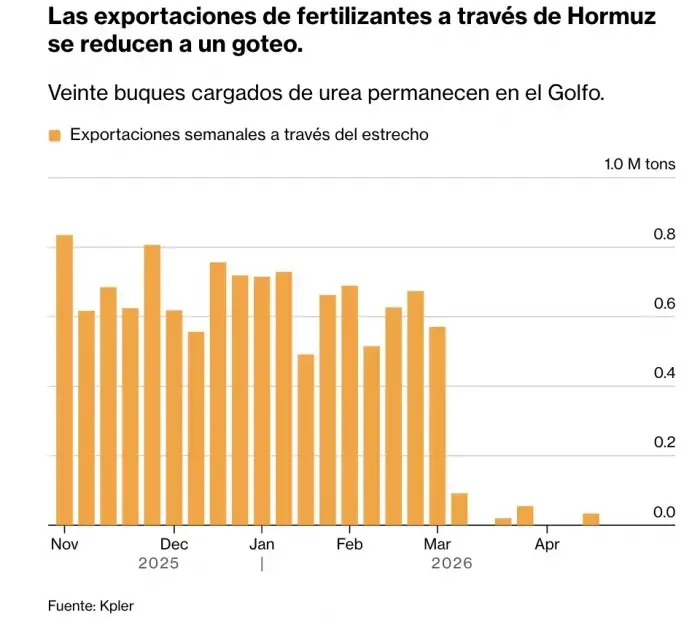
The closure of the Strait of Hormuz halts urea exports, reduces global supply, and raises concerns about agricultural costs and inflationary pressure.
More than 55% to 60% of urea production in the Middle East has been affected since the end of February 2016, when the conflict with Iran led to the operational closure of the Strait of Hormuz, according to data compiled by our newsroom. This figure is key: the region accounts for approximately 45% of the global urea trade, making it a strategic hub for the supply of fertilizers worldwide.
The impact is not limited to production. The crisis combines a drop in supply with an unprecedented logistical blockade, as large volumes of urea remain stranded in the Persian Gulf, unable to leave, while new ships are unable to enter. This is causing a rapid adjustment in the global availability of fertilizers, with a direct impact on production costs.
At the same time, attacks on energy and industrial infrastructure in countries like Qatar and Bahrain are affecting the production capacity of this input. Thus, the market faces a double shock: less urea available and increasing difficulties in transporting it.
The magnitude of the problem is reflected in maritime transport: since the beginning of the conflict, only 11 ships carrying fertilizers have managed to cross the Strait of Hormuz, of which only four were carrying urea, while 44 vessels remain stranded in the Gulf, almost half of them loaded with this product.
- Exports have fallen to minimal levels, affecting global trade.
- Storage capacity is beginning to reach its limit in producing countries.
- The impact is already reaching key importers such as India, Europe, and Brazil.
In the short term, producers used the immobilized ships themselves as floating storage. However, this strategy has its limits. As storage facilities fill up, the risk grows that plants will have to halt production due to lack of space, further deepening the crisis.
Unlike other sectors, nitrogen fertilizer plants cannot restart quickly, so any closures could extend the effects of the shock for months.
The impact is directly felt in agriculture. Urea is the most widely used nitrogen fertilizer globally, crucial for crops like corn, wheat, and rice, and difficult to replace due to its high nutrient concentration. In this context, reduced availability could translate into lower application rates, decreased yields, and greater volatility in agricultural markets.
Even with the eventual reopening of the Strait of Hormuz, analysts warn that the delay in shipments will have a cumulative effect, prolonging price pressures and highlighting the fragility of global agricultural input supply chains.
Source: AgroLatam.com
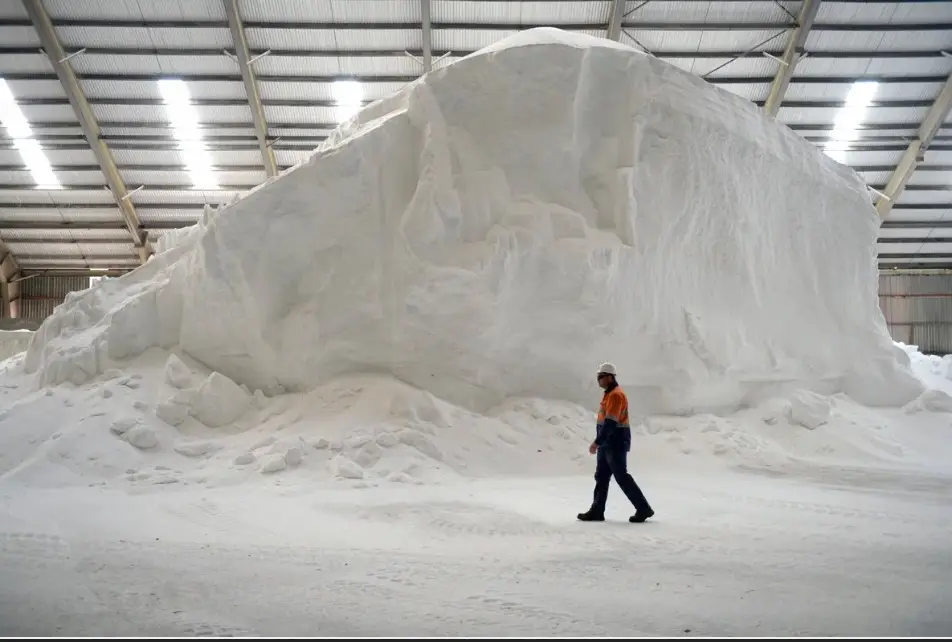
BRAZIL: Fertilizer prices rise by up to 63%, putting pressure on Brazilian agriculture
The rise in urea prices worsens the trade with corn and leads producers to reconsider purchases.
The surge in fertilizer prices on the international market, driven by the outbreak of conflict in the Middle East, has significantly deteriorated the terms of trade for Brazilian farmers. According to StoneX, a global financial services company, in a scenario of strong import dependence, Brazil is directly feeling the impacts of this external shock, with a significant increase in the price of inputs in the domestic market.
Among nitrogen fertilizers, the increase is even more pronounced. Since the beginning of the conflict, CFR urea prices have risen by about 63% in the country. During the same period, ammonium sulfate (SAM) has accumulated an increase of nearly 30%, while ammonium nitrate (NAM) has registered an appreciation of approximately 60%.
According to the report, the surge in urea prices has led to a significant deterioration in the terms of trade, especially for corn producers. Currently, approximately 60 sacks of corn are needed to purchase one ton of urea, one of the worst levels in recent years.
“We are facing a significant deterioration in the terms of trade, which directly puts pressure on producer margins and makes purchasing decisions more complex at this time,” emphasizes Market Intelligence analyst Tomas Pernías.
The scenario also affects soybean producers, who face unattractive conditions for acquiring phosphate fertilizers. With high costs, the trend is towards more cautious, selective demand focused on reducing expenses, which could slow the pace of purchases in the country.
Despite this, the agricultural calendar imposes limits. The main window for purchasing fertilizers occurs in the second half of the year, before the summer harvest. In recent weeks, some producers have adopted a defensive stance, postponing decisions due to price volatility.
However, this postponement cannot be extended indefinitely. As the calendar progresses, farmers will have to choose between absorbing higher costs, with a direct impact on margins, or reducing the application of inputs, assuming potential risks to productivity.
“At some point, the producer will have to make a decision. Whether accepting higher prices or adjusting the technological package, which may have repercussions on productivity. The next developments in the conflict will be decisive for the behavior of demand in Brazil,” concludes Pernías.
Source: Cultivar Magazine

Indonesia will supply 250,000 tonnes of urea to Australia to mitigate global shortages
Australia has secured an agreement to import approximately 250,000 tonnes of agricultural-grade urea from Indonesia, as authorities move to stabilize fertilizer supplies disrupted by geopolitical tensions in the Middle East. The deal between Incitec Pivot Fertilisers and PT Pupuk Indonesia is expected to cover roughly 20% of the country’s remaining fertilizer needs for the current season, with deliveries scheduled between May and December.
The agreement comes as supplies from the Persian Gulf—traditionally accounting for around 60% of Australia’s urea imports—remain constrained due to ongoing regional conflict. Incitec Pivot said the additional volumes, secured at prevailing market prices, would play a key role in supporting domestic agricultural output and regional food security. The arrangement was facilitated with support from both the Australian and Indonesian governments, underscoring efforts to diversify sourcing and maintain supply continuity.
Alongside the import deal, the Australian government has introduced temporary changes to biosecurity procedures to accelerate fertilizer imports from non-traditional suppliers such as Nigeria and Oman. Measures include simplified offshore certification, streamlined inspection processes, and new sampling requirements for higher-risk imports. Officials said the reforms were developed in consultation with industry and are intended to reduce delays while maintaining strict biosecurity standards.
The supply push follows recent diplomatic efforts by Prime Minister Anthony Albanese and Foreign Minister Penny Wong to strengthen ties with Southeast Asian producers, including Brunei and Malaysia. While no immediate increase in imports was agreed during the Brunei visit, both sides signaled willingness to expand cooperation on fertilizer and energy supplies. Despite these efforts, authorities acknowledged that supply constraints may persist later in the year, with additional measures under consideration to ensure adequate availability for farmers.
Source: AgroPages


US Senator to file bill to end Morocco phosphate duties
US Senator Roger Marshall (Republican, Kansas) teased plans for the legislation on Tuesday alongside US Department of Agriculture (USDA) and White House cabinet officials as part of a greater effort to alleviate cost pressures on growers.
The Lowering of Input Costs for American Farmers Act would eliminate the countervailing duties on phosphate imports from Morocco, the leading global producer. If enacted, the elimination of the duties will lower the cost of phosphate fertilizer by over 20%, or roughly US$150/short t.
US phosphate prices have trended higher than historic norms since countervailing duties on imports from both Russia and Morocco were imposed in 2021 after US producer Mosaic alleged the two countries’ phosphate imports materially injured the US market.
US combined imports of DAP and MAP reached a record 1.85 million t in 2018, but have averaged just 182 300 tpy from 2021 – 2025, according to US Commerce data.
But the announcement comes just roughly two months after the start of the US Department of Commerce’s five-year sunset review of the duties, in partnership with the US International Trade Commission.
Throughout the speech, the USDA along with other federal entities cited a variety of short-term and long-term actions being taken to ease pressures felt by growers, mostly in relation to various supply issues and concerns that have significantly elevated fertilizer costs. Alongside Marshall’s bill, other legislation has been also been filed with aims to lower fertilizer costs such as the Fertilizer Price Transparency Act and the Fertilizer Research Act.
US phosphate imports have been marked by years of turmoil, with the product’s imports being notably deterred by import tariffs, countervailing duties and more recently the loss of seaborne tons from Saudi Arabia through the Strait of Hormuz because of the Middle East Gulf war.
Source: World Fertilizer
ARGENTINA MAIN CROPS OVERVIEW
SOYBEANS: After a week-on-week increase of 8 percentage points, the soybean harvest has reached 18.3% of the 17.2 million hectares planted, with a national average yield of 37 quintals per hectare. While harvesting is gaining momentum and is almost 4 percentage points ahead of last season, it is still 11 percentage points behind the average of the last five seasons. As for first-crop soybeans, the harvest is progressing smoothly in both growing regions, with yields averaging 39.6 quintals per hectare in the Northern region and 40.5 quintals per hectare in the Southern region, values higher than historical averages. It’s worth mentioning that in northern La Pampa and western Buenos Aires, although harvesting is delayed due to waterlogged fields, current yields average 41.4 quintals per hectare (qq/Ha), exceeding historical averages, thanks to accumulated rainfall throughout the growing season. Meanwhile, second-crop soybeans have reached 1.3% of the suitable area, with 84% of the planted area still standing and exhibiting normal to excellent crop conditions. Given this context, we maintain our production forecast at 48.6 million tons (MTn).
CORN: Regarding corn, after a week-on-week increase of 1.5 percentage points, the harvest has reached 28% of the suitable area, with an average yield of 86.8 qq/Ha. Weather conditions are beginning to improve across much of the agricultural region, allowing harvesting to gradually resume. However, collaborators from different regions report that the early soybean harvest continues to be prioritized, limiting the pace of progress. Regionally, yields are at 100.5 quintals/hectare in the Northern Core region and 95.4 quintals/hectare in the Southern Core region. Regarding late-planted corn, the proportion of fields at physiological maturity is increasing, while the rest of the area is in the final stages of its cycle. In this context, crop conditions remain favorable, with 97.8% of the area rated between Normal and Excellent. Given this scenario, we maintain our production forecast at 61 million tons.
SUNFLOWER: Finally, after a week with virtually no rain in the harvesting areas, sunflower harvesting showed week-on-week progress of 5.7 percentage points, reaching 97% of the suitable area, just 1.6 percentage points below the average progress of the last five seasons. Despite significant yield variability, average results were higher than those recorded in previous weeks, and even exceeded producer expectations, particularly in southeastern Buenos Aires province, which accounts for 19% of the planted area. This positive trend translates into an increased projected harvest volume, rising from 6.4 to 6.6 million tons.
Source: Buenos Aires Grain Exchange