
The joint military operation between the US and Israel against Iran triggered a response from the Persian nation, leading to the blocking of oil shipments through the Strait of Hormuz and destabilizing the entire Middle East region.
This region is central to the production and trade of nitrogen fertilizers, meaning that if the conflict continues for several weeks—or even months—access to this essential agricultural input could be compromised.
This is not good news for grain producers, as the grain-to-fertilizer ratio was already unfavorable before the US and Israeli attacks against Iran began.
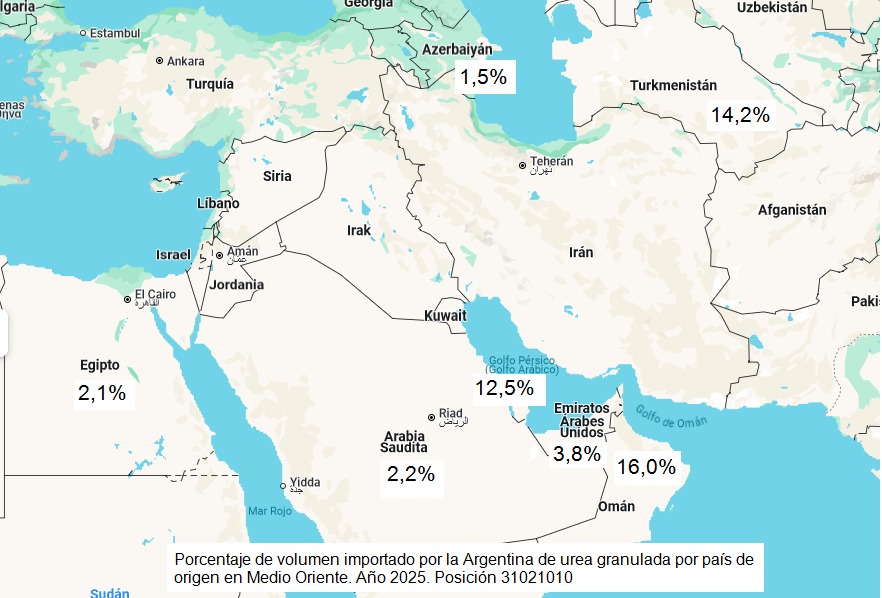
Official data shows that 63% of the granulated urea imported by Argentina in 2025 came from the currently conflict zone, posing a challenging outlook for fertilizer supplies for the 2026/27 winter grain season.
Last year, 1.52 million tons of urea entered the Argentine market, the majority (16.0%) coming from Oman, followed by Turkmenistan with 14.2%, Qatar with 12.5%, and the United Arab Emirates with 3.8%. Smaller volumes were imported from Saudi Arabia, Egypt, and Azerbaijan.
The level of commitment from each country is currently variable, with some nations suspending operations at hydrocarbon and fertilizer plants due to missile attacks from Iran, while others continue operating under conditions of great uncertainty.
The other issue to be resolved is transportation, since most insurers have raised risk premiums for vessels transiting the area, increasing freight costs and reducing the number of shipping companies interested in operating in the region.
In this context, it is very likely that international urea prices will continue their upward trend, whether due to lower production in a key area or difficulties in marketing the fertilizer.
Soybean Value by Valor Soja, March 2, 2026
Fertilizer Prices Have ‘Significant’ Rise After Attack on Iran
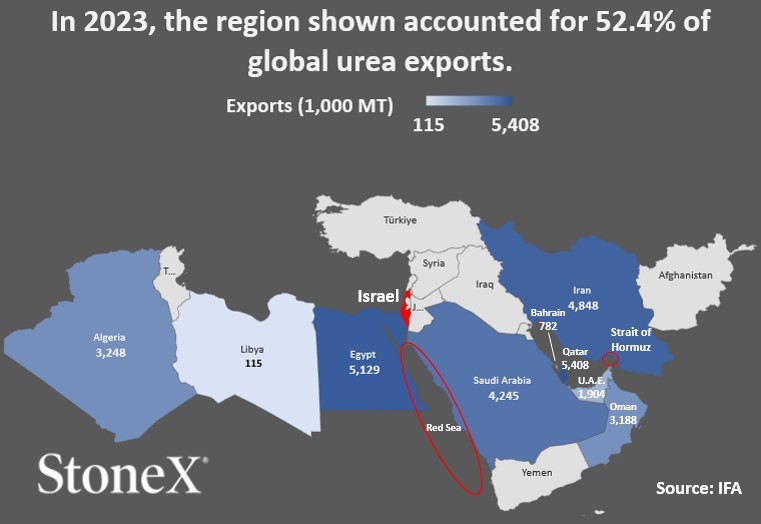
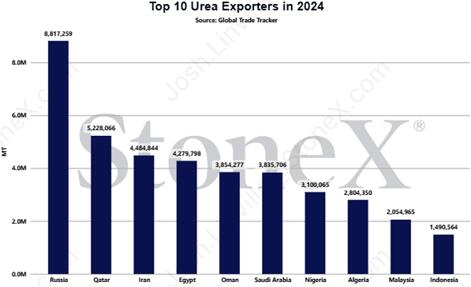
Progressive Farmer’s Russ Quinn reported that “farmers could see even higher fuel and fertilizer costs for this spring with the start of the military conflict between the U.S. and Israel against Iran in the Middle East.”
“The now closed Strait of Hormuz moves about 20 million barrels of crude oil and other petroleum products each day, which is about 20% of global demand. Diesel futures prices moved to a two-year high on Monday,” Quinn reported. “Fertilizer exports also move through the strait. About a quarter of the globally traded nitrogen market moves through the waterway, according to a fertilizer analyst.”
“As a result, nitrogen fertilizer at the port of New Orleans has seen an increase in price this week,” Quinn reported. “Urea prices for barges in New Orleans traded $520 per ton to $550 per ton on Monday, up from an average of $475 per ton last week, according to CRU Group.”
AgWeb’s Michelle Rook reported that “fertilizer prices were already at historical highs prior to the conflict. [Josh] Linville [vice president of fertilizer for StoneX] reports urea markets saw the sharpest increases, followed by phosphate.” …‘We have had prices up about $70 a ton from Friday afternoon trade. It’s been significant,’ Linville says. UAN and anhydrous prices have not reacted as violently, but phosphate values are not far behind.”
“‘Phosphate, we’ve got that price up about $30 a ton from the last trade we had seen. Again, [I’m] a little surprised it’s not up more. That’s, I guess, a thankful thing that’s not up more, but I think more increases are coming. Really, the only major fertilizer that hasn’t been impacted so far is potash. But you can even make a case for that given Israel and Jordan’s importance,’ he adds,” according to Rook’s reporting.
Fertilizer Supply Could Be an Issue, Too
Rook reported that “higher prices aren’t the only problem: Supply is in jeopardy. Linville says, from a timing standpoint, it could not be worse for agriculture. A multi-week conflict could keep some supply from getting to the U.S. in time for spring planting.”
“‘It takes 30 days to get a vessel of urea to load in the Persian Gulf, sail it over here, hit U.S. shores, and then another three to four weeks to move that product into the interior of the nation to a point where the farmer can put their hands on it,’ Linville says,” according to Rook’s reporting. “This means a vessel loading today might not be available until May 1. The window for spring application is closing quickly.”
“While healthy fertilizer import volumes in February provide some cushion, the industry could see a shift in acreage,” Rook reported. “Some farmers may move from corn to soybeans if nitrogen supplies do not arrive in the Corn Belt in time.”
Trump Admin to Offer Escorts Through Strait of Hormuz
Politico’s Ben Lefebvre and Jack Detsch reported that “the White House will offer naval escorts and political risk insurance for oil and gas tankers traversing the Strait of Hormuz, President Donald Trump said Tuesday, in a bid to cool energy prices that have surged since Iran warned it would attack ships at the choke point.”
“The announcement brought some immediate relief to the overheated crude oil market, curbing the rally that had added more than $10 a barrel of oil since the U.S. and Israel began launching strikes against Iran on Saturday,” Lefebvre and Detsch reported. “Still, energy markets remain nervous that key oil and gas assets in the Persian Gulf may be targeted by Tehran.”
“‘Effective IMMEDIATELY, I have ordered the United States Development Finance Corporation (DFC) to provide, at a very reasonable price, political risk insurance and guarantees for the Financial Security of ALL Maritime Trade, especially Energy, traveling through the Gulf,’ Trump said in a Truth Social post,” according to Lefebvre and Detsch’s reporting. “‘This will be available to all Shipping Lines. If necessary, the United States Navy will begin escorting tankers through the Strait of Hormuz, as soon as possible.’”
Linville said on X that there are “no guarantees” the Trump administration’s assurances to provide safe passage to ships through the Strait of Hormuz “will work but if it does, it could limit the damage to fertilizer and could have corrections coming. Timing is everything.”
Source: SF Successful Farming by Farmdoc
BRAZIL. Mosaic now declares the solubility of phosphorus in mixtures.
According to the company, the initiative anticipates market practices.
The Ministry of Agriculture has made it mandatory to declare the solubility rate of phosphorus pentoxide (P2O5) in water for complex mineral fertilizers. Mosaic reports that it has also started declaring this indicator for granular mixtures.
According to the company, the initiative anticipates market practices and reinforces transparency. The move consolidates technical work conducted by the company in partnership with the National Union of Raw Materials Industries for Fertilizers.
By including phosphorus solubility information on packaging, including in blends, the company expands the scope of information beyond the minimum requirement. This measure contributes to the more efficient use of inputs and to sustainable agricultural practices.
“Solubility is an essential technical factor for the efficiency of fertilization and for the utilization of nutrients by plants. It determines how, how much, and when nutrients become available to crops, with a direct impact on efficient use, management, and the sustainability of production,” says Luis Arruda, marketing director at Mosaic.
Source: Cultivar Magazine

Grupa Azoty introduces sulphur-based fertilizer as it reinforces core business

Grupa Azoty has launched a new nitrogen–sulphur fertilizer, adding to its portfolio as it continues to position fertilizers as the central pillar of its business.
The fertilizer segment is expected to provide company’s operational stability and competitive scale in the European market, while supporting agricultural production in Poland and neighboring countries.
The new product, DuoS, combines nitrogen, sulphur and calcium in a single formulation. It is designed to address nutrient losses linked to leaching and the instability of certain nitrogen and sulphur forms.
The formulation contains two types of nitrogen—nitrate and ammonium—and two sulphur sources, ammonium sulphate and anhydrite. Calcium has been added to support crop resilience and yield quality.
The product’s sulphur-release profile is structured to ensure availability both in early growth stages and later in the season. The nitrogen-to-sulphur ratio has been adjusted to better reflect crop uptake patterns and reduce the risk of excessive stimulation during sensitive periods such as early spring and late autumn.
The launch is part of a broader plan to expand the group’s range of more specialized fertilizers in the current season.
Source: Fertilizer Daily
ARGENTINE MAIN CROPS OVERVIEW:
SOYBEANS: Recent rainfall has improved the soil moisture conditions for soybeans, primarily in Northwest Argentina (NOA), central Santa Fe, southern Córdoba, and western Buenos Aires. However, the Optimal/Adequate soil moisture condition decreased by 2 percentage points, as much of Chaco, northern Santa Fe, and central and southern Buenos Aires still require further rainfall. In this context, 74% of the planted area is in Normal/Excellent condition, showing improvement after the recent rains. Meanwhile, 27% of the first-crop soybeans have begun grain filling, awaiting further rainfall to maintain their yield potential. At the same time, 40% of the second-crop soybeans are in the yield-defining stage with water limitations, especially in both the northwestern and southern regions. Under these circumstances, the production forecast remains at 48.5 million tons (MTn).
CORN: On the other hand, after a week-on-week increase of 3.6 percentage points, the corn harvest has reached 7.2% of the national area, with work concentrated in the Northern Core and Central-Eastern regions of Entre Ríos, where yields average 95.7 and 65.2 quintals per hectare, respectively. Meanwhile, initial progress is being made in the Southern Core, Central-Northern Córdoba, and Central-Northern Santa Fe. Regarding late-planted corn, 73.9% of the area is in Adequate to Optimal soil moisture conditions, representing a 4.7 percentage point improvement after recent rainfall. Crop conditions remain mostly favorable, with 87.4% of fields in Normal to Excellent condition. In this context, the 57 million ton (MTn) production forecast remains unchanged.
SUNFLOWER: Finally, regarding sunflowers, in the last week, harvesting progressed by 2.8 percentage points, covering 33.8% of the suitable area. This progress stems from the start of the harvest in the Southern and Northern Core areas of La Pampa and Western Buenos Aires, with average yields between 25 and 30 quintals per hectare (qq/Ha), and the first fields in Southern Córdoba, San Luis, and Southern La Pampa and Buenos Aires, with variable yields between 15 and 25 qq/Ha. The average yield is 23 qq/Ha, resulting in a harvested volume of 2.08 million tons (MTn) to date. Given that two-thirds of the oilseed area remains to be harvested, the production forecast remains at 6.2 MTn.
Source: Buenos Aires Grain Exchange