
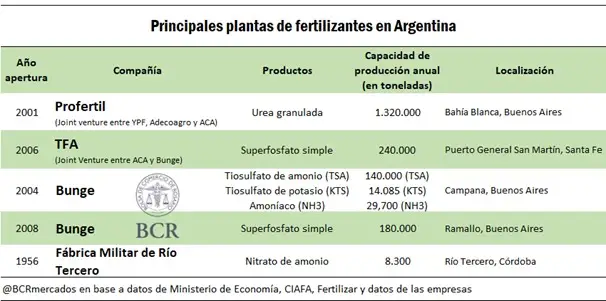
Although local production is around 1.7 million tons, more than half of the fertilizers used in the country come from abroad. China, Morocco, and the United States are the main suppliers.
The global fertilizer market is dominated by a few countries. China is the leading producer and consumer, followed by Morocco, Russia, the United States, and India. In this context, prices and local availability usually depend on international supply and demand conditions.
In Argentina, the situation reflects this dependence: 56% of the fertilizers used are imported, mainly from Morocco, China, the United States, and Peru. This proportion increases in years of high agricultural demand or when international prices fall.
Local Production: More Nitrogen, Less Potassium
National production reaches 1.7 million tons per year, with nitrogen fertilizers predominating (68%), used to stimulate plant growth. Phosphate fertilizers (25%), which promote flowering and root growth, are next, followed by sulfur fertilizers (7%) and a minimal proportion of potassium fertilizers.
Most of the production and distribution plants are located in Buenos Aires, Santa Fe, and Córdoba, where the port terminals for the import and export of these products are also concentrated.
Consumption is consolidating.
During the 2024/25 season, total fertilizer use reached 4.8 million tons. Corn was the main consumer, accounting for 38% of the total, followed by wheat (27%), soybeans (8%), barley (7%), and regional crops, which together accounted for another 11%.
The market’s leading fertilizer continues to be urea, representing 76% of nitrogen fertilizer use. Among phosphate fertilizers, monoammonium phosphate (MAP) predominates, with 52% of consumption, followed by single superphosphate and diammonium phosphate (DAP).
Despite some efforts to increase local production, the country remains highly dependent on foreign trade. Over the past fifteen years, imports have averaged USD 1.225 billion annually, peaking in 2022 due to the Russia-Ukraine conflict and rising international prices.
The main entry points are the ports of San Nicolás, San Lorenzo, and Ramallo, which handle more than 80% of the imported volume.
Greater Efficiency, Less Impact
The growth in fertilizer use reflects the search for higher yields in a context of tight margins. However, experts warn of the need to improve application efficiency and reduce losses due to leaching or volatilization, especially with nitrogen fertilizers.
At the same time, interest in biofertilizers and controlled-release technologies is growing, alternatives that could reduce costs and environmental impact.
Source: Report “The Fertilizer Market in Argentina and the World,” Buenos Aires Grain Exchange.
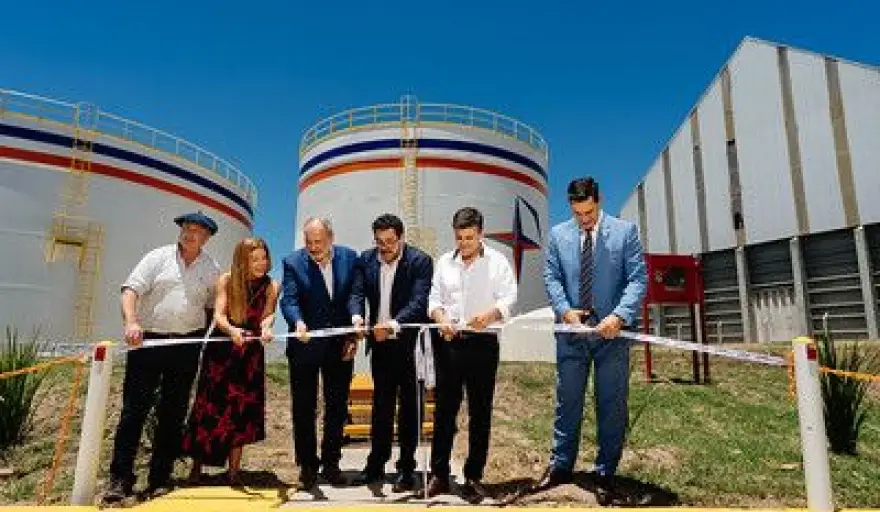
Milestone in Uruguay: PTP Group Inaugurates New Liquid Fertilizer Plant in Nueva Palmira
PTP Group has launched the first phase of its plant in Uruguay, designed for the storage of agricultural inputs and biofuels.
PTP Group Logistics officially inaugurated its new liquid fertilizer storage facility in Nueva Palmira, Uruguay.
The opening ceremony was attended by government and port authorities, including the Secretary of the Presidency of Uruguay, Alejandro Sánchez; the Mayor of Soriano, Guillermo Besozzi; and the Director of the National Ports Administration (ANP), Jorge Gandini.
The first phase of the terminal incorporates tanks built according to the strict API 650 standards, guaranteeing safety and quality in the handling of liquid bulk cargo. According to the company, this initial phase consists of a 6,250 m³ steel tank (the first of three planned) and an additional 2,500 m³ unit, for an initial storage capacity exceeding 8,000 m³.
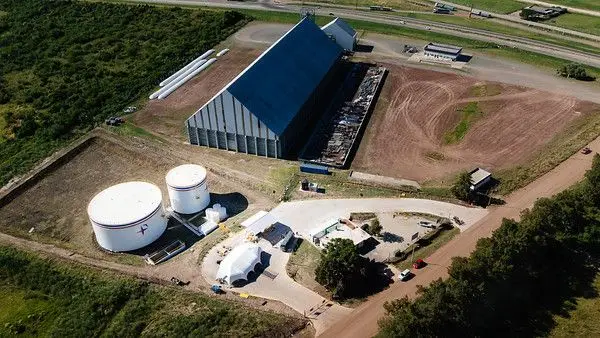
Eduardo Domínguez Espinosa, the company’s Country Manager, explained the operational dynamics of the new facility: “The first tanks will store liquid fertilizers, primarily from the United States and Russia, destined for the local market. In a later phase, the terminal will also receive biofuels and vegetable oils.”
The logistics plan includes receiving products from ocean-going vessels at the public port, unloading them onto tanker trucks, and transporting them to the terminal, located just 800 meters from the dock, where the cargo will be stored before final shipment.
Guillermo Misiano, President and CEO of PTP Group, highlighted that this river corridor was the gateway to the company’s internationalization in 2010.
This operation adds to the company’s recent activity at the port of Nueva Palmira. In November, PTP Group unloaded bulk fertilizer from a Panamax-class vessel at the same terminal.
Source: Data Portuaria

Mosaic warns of North American fertilizer demand slump in fourth quarter

Mosaic opens new tab warned on Friday that an unusually steep drop in North American fertilizer demand during the fourth quarter has weighed on its sales and cash flow, sending the company’s shares declining more than 6% in premarket trading.
Demand fell as farmers cut fertilizer use amid tight budgets, while an early onset of winter shortened the application window for the products.
Market conditions were particularly challenging for phosphates, which were less affordable relative to potash, Mosaic said.
Phosphate shipments in North America were down about 20% from a year earlier, while potash demand was only modestly weaker, it said.
The U.S. fertilizer producer reported phosphate sales of about 1.3 million tonnes for the fourth quarter, below its previous forecast of 1.7 million to 1.9 million tonnes. Potash sales of roughly 2.2 million tonnes were also lower than its prior projection of 2.3 million to 2.6 million tonnes.
In Brazil, Mosaic said tighter credit conditions and increased competition, including imports of lower-analysis phosphate from China, weighed on demand and margins, leaving fourth-quarter volumes at its Mosaic Fertilizantes unit well below plans.
Fertilizantes sales were roughly 9 million tonnes for the full-year 2025, flat year-on-year but reflected a broader downturn, the company said.
Mosaic is set to report its fourth-quarter results on February 24.
Source: Reuters
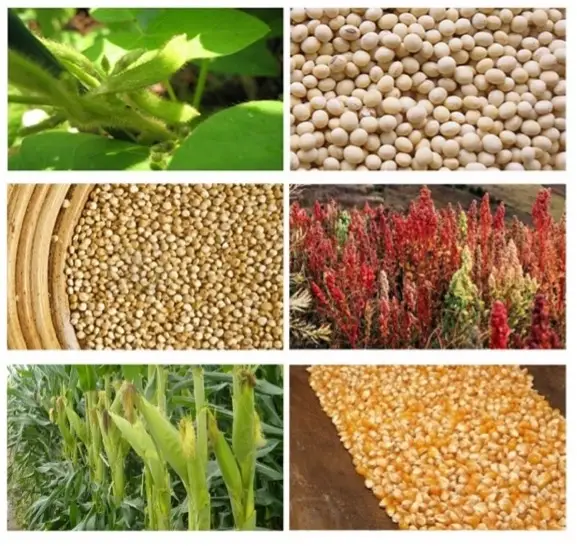
ARGENTINA MAIN CROPS OVERVIEW:
SOYBEANS: Planting covers 93.9% of the projected area. Although a decrease in soil moisture is being recorded, 95.1% of the planted area is in Normal/Good condition.
CORN: Corn planting has reached 91.7% of the projected national area. 74% of the early corn is in its critical period, with 93% of the crop in Normal to Good condition.
SUNFLOWER: Harvesting covers 16.3% of the suitable area, with an average yield of 22.5 quintals/hectare. 33% of the planted area is in full bloom. 96% of the area is in Normal/Excellent condition.
SORGHUM: Sorghum planting has reached 83.3% of the projected area, with the pace being influenced by the greater water availability in the north. The first planted fields are beginning to flower.
WHEAT: The harvest concludes with a cumulative production of 27.8 million tons and a national average yield of 43.5 quintals per hectare, 43.1% and 50.4% higher than the previous season and the average of the last five.
Source: Buenos Aires Grain Excha